

CG Policy · 2025
In this section7 topics
Corporate Governance Policy
Introduction
The Company recognizes the importance of good corporate governance as a crucial factor that promotes the Company's efficient operations and sustainable growth, which will lead to maximum benefits for all stakeholders, including employees, investors, shareholders, and other interested parties. Therefore, the Board of Directors deems it appropriate to establish a good corporate governance policy, covering key principles from the structure, roles, duties, and responsibilities of the Board of Directors, to the principles of transparent, clear, and auditable management by executives, to serve as a guideline for organizational management, ensuring that all operations of the Company are conducted fairly and with the utmost consideration for the benefits of all shareholders and stakeholders.
To ensure the Company's credibility among all shareholders and stakeholders, and for the benefit of creating sustainable value for the business, in line with the expectations of the business sector, investors, as well as the capital market and society as a whole, the Board of Directors adheres to the laws, objectives, regulations, and resolutions of the Company's shareholders' meetings. The Board is committed to conducting business according to good corporate governance principles and internationally accepted best practices, with honesty, integrity, ethics, transparency, and social responsibility, to enable the Company to grow as a sustainable organization.
Sub-Section Introduction
The company has a good corporate governance system, capable of improving operational efficiency and effectiveness, increasing opportunities, and reducing business risks, which leads to building confidence among stakeholders such as shareholders, employees, customers, communities, and society.
Key individuals who play a crucial role in ensuring that the business has an effective corporate governance mechanism include shareholders, the Board of Directors, Management and employees, who have diverse roles, duties, and responsibilities, but share the common essential principle of performing their duties with integrity, fairness, transparency, and accountability to enable the organization to achieve its stated objectives.
The company has established a good corporate governance policy and various guidelines appropriate to its business context, serving as a framework for directors, executives, and employees to adhere to and follow. It also has a system for monitoring, overseeing, and disclosing practices to stakeholders to reflect transparency in operations to all relevant parties, under the fundamental principles of corporate governance that recognize the rights of various stakeholders, including shareholders, customers, employees, business partners, trade partners, society, communities, and the environment. This is reflected through its vision and business ethics, with a policy to ensure that each stakeholder group receives satisfaction and fully exercises their rights based on principles of fairness for sustainable mutual growth.
This is a result of the Board of Directors' emphasis on corporate governance and sustainable business development, and its promotion of the company to Leading implementing these guidelines in its operations, which is a source of pride for the company, as follows:
Sustainable Stock Assessment Year 2025 or SET ESG Ratings 2025, the company received an AA rating from the Stock Exchange of Thailand.
Thai Listed Companies Corporate Governance Report (CGR) Assessment Year 2025 (CGR), the company received a 5-star rating, categorized as "Excellent", for the second consecutive year. Furthermore, the company was ranked in the Top Quartile of listed companies by market capitalization (Market Capitalization) 10,000-30,000 million Baht from the aforementioned survey and assessment, which was evaluated by the Thai Institute of Directors (IOD) with the support of the Stock Exchange of Thailand.
Annual General Meeting Quality Assessment 2025 (AGM Checklist), the company received a perfect score of 100 or 5 stars for the second consecutive year from the Thai Investors Association.
Has a Corporate Governance Policy
Yes
Policy Description
The Board of Directors emphasizes conducting business in accordance with good corporate governance principles, with transparency, integrity, ethics, and responsibility towards society, environment, and all stakeholder groups, as well as supporting actions to prevent and combat all forms of corruption to create long-term value and good performance, and to enhance confidence and trust for shareholders, investors, and all stakeholders, which will lead to sustainable growth. Therefore, the Company has established a written Good Corporate Governance Policy, consistent with the practices under the Corporate Governance Code for Listed Companies 2017 (CG Code) as prescribed by the Securities and Exchange Commission, and in accordance with the evaluation criteria for the Corporate Governance Report of Thai Listed Companies by the Thai Institute of Directors Association, and is committed to continuously developing corporate governance to meet international standards.
Practice 1 : Recognize the role and responsibility of the Board of Directors as organizational leaders who create sustainable value for the enterprise.
1. The Board of Directors understands its role and recognizes its responsibility as a leader to oversee. to ensure good organizational management. The Company has established a Board of Directors' Charter, which clearly defines the powers, duties, and responsibilities for both performing duties and overseeing the Company's operations in compliance with laws, objectives, regulations, resolutions of the Board of Directors' meetings, and resolutions of the Shareholders' meetings, with responsibility, duty of care, and duty of loyalty, considering relevant laws, rules, and regulations, such as Sections 89/7, 89/8, 89/9, and 89/10 of the Securities and Exchange Act B.E. 2535 (1992) (including amendments), to protect the rights and interests of all shareholders, which includes (1) defining objectives, vision, mission, and goals, (2) establishing business strategies and operational policies, (3) allocating key resources and overseeing the administration and management of management, and (4) monitoring, evaluating, and overseeing the reporting of the performance of the Company and its subsidiaries to achieve the Company's objectives and goals.
2. The Board of Directors shall establish various policies, such as an anti-corruption policy, including a code of conduct, to ensure ethical, verifiable business operations that respect the rights of shareholders and stakeholders, and are beneficial to society and the environment, as well as adaptable to changing factors, to create sustainable value for the enterprise. The Board of Directors shall monitor the Company's compliance with established policies and review policies at least once a year.
3. The Board of Directors shall ensure that sufficient systems and mechanisms are in place to guarantee that the Company's operations comply with laws, objectives, regulations, resolutions of the Board of Directors' meetings, and resolutions of the Shareholders' meetings.
4. The Board of Directors shall establish charters for the Board of Directors and its sub-committees, and shall review these charters. to be consistent with current conditions, rules, regulations, and changing circumstances, at least once a year.
Practice 2 : Define the main objectives and goals of the enterprise for sustainability.
1. The Board of Directors has established the organization's main objectives and goals for business operations to achieve sustainability and align with creating value for the enterprise, customers, all stakeholders, and society as a whole. It also communicates these principles to personnel at all levels to adhere to in performing their duties, to achieve the defined objectives and goals, and to foster an organizational culture, considering, (1) environmental conditions and changing factors, as well as the application of innovation and technology to improve work and build an organizational foundation, (2) the needs of customers and stakeholders, and (3) competitive capabilities, expertise, opportunities, and business risks.
2. The Board of Directors shall promote the adoption of new technologies and innovations to ensure efficient business operations in accordance with established policies, and shall also ensure that objectives, goals, and strategic plans are reviewed to align with the enterprise's main objectives.
Practice 3 : Strengthen an effective Board of Directors.
The Company has a policy to establish and review the Board's structure to be appropriate and consistent with the Company's business and size, and in accordance with legal requirements, as follows:
1. The Board of Directors comprises individuals with diverse qualifications in terms of knowledge, abilities, experience, gender, and age, who can contribute to the Company's benefit.
2. The Board of Directors shall consist of at least five (5) persons but not exceeding twelve (12) persons, comprising independent directors in a number not less than prescribed by law, which will ensure appropriate balance in considering and voting on various matters. All independent directors of the Company possess qualifications as stipulated in the announcements of the Capital Market Supervisory Board, the Stock Exchange of Thailand, as well as other relevant rules, regulations, and laws.
3. The Board of Directors shall ensure the recruitment of individuals with appropriate knowledge, expertise, and experience who can perform duties beneficial to the Company's business, to be proposed to the Board of Directors' meeting and/or the Shareholders' meeting (as the case may be) for consideration and appointment as directors of the Company. The Company shall disclose information of its directors and sub-committee members, such as age, gender, educational background, experience, shareholding proportion, years in position, number of meetings attended, remuneration of the Board of Directors (both monetary and non-monetary), directorships in other listed companies, roles, duties, and responsibilities, and performance reports of the Board of Directors and sub-committees in the annual information statement/annual report form 56-1 One Report of the Company and/or on the Company's website.
4. The Board of Directors is responsible for overseeing that the nomination and selection of directors follow a transparent and clear process to ensure that the Board of Directors comprises individuals with qualifications consistent with the established composition.
5. Directors shall hold office for a term not exceeding three (3) years as prescribed by relevant laws. Independent directors shall serve for a continuous term not exceeding nine (9) years, unless there are reasons and necessities deemed appropriate by the Board of Directors.
6. Directors and executives of the Company may hold directorships or executive positions in affiliated companies or other companies, but this must not impede their duties as directors of the Company and must comply with the requirements of the Securities and Exchange Commission, the Capital Market Supervisory Board, and the Stock Exchange of Thailand, as well as other relevant rules, regulations, and laws. They should attend at least seventy-five percent (75) of the total number of Board meetings to be held in that year.
6.1 Directors should be able to hold directorships in other listed companies on the Stock Exchange of Thailand. not exceeding five (5) companies.
6.2 The Chief Executive Officer shall assume directorships or executive positions in any other company, provided that notification must be given to. the Board of Directors' meeting for acknowledgment, except for assuming positions that the Company may consider appointing to as directors or executives of subsidiaries, in proportion to the investment, to oversee subsidiaries' compliance with the Company's policies for the Company's utmost benefit.
7. The Board of Directors shall select a suitable person as the Chairman and ensure that the composition and operations of the Board facilitate independent decision-making. The Chairman and the Chief Executive Officer of the Company shall not be the same person to ensure clarity in responsibilities between policy formulation and day-to-day management. The Company has clearly defined the authority and responsibilities of the Chief Executive Officer and stipulates that the Chairman of the Board must be an independent director.
8. The Board of Directors has appointed sub-committees to support the operations of the Board of Directors and the Company's business, namely the Audit Committee, the Executive Committee, the Nomination and Remuneration Committee, the Risk Management Committee, and the Corporate Governance and Sustainable Development Committee.
9. The Board of Directors shall consider directors' remuneration as proposed by the Nomination and Remuneration Committee. Directors shall receive remuneration in the form of meeting allowances and a fixed monthly remuneration. The meeting allowance rates shall be benchmarked against other companies in the same industry. The remuneration determination process must be transparent and approved by shareholders. The level and components of remuneration must be appropriate for the responsibilities and sufficient to incentivize the Board of Directors to lead the organization in achieving both short-term and long-term goals, and to retain qualified directors, while avoiding excessive remuneration.
Executives of the Company and its subsidiaries shall receive both fixed remuneration as salaries, benchmarked against remuneration of other companies in the same industry, and variable remuneration in the form of bonuses. These will be determined based on their positions, responsibilities, and the Company's performance under their management, with fair and transparent consideration, and to incentivize executives to achieve both short-term and long-term goals.
10. The Company has stipulated in the charters of the Board of Directors and its sub-committees that each committee is responsible for evaluating the annual performance of the Board of Directors and its sub-committees, both collectively and individually.
Practice 4 : Recruit and develop senior executives and manage personnel.
1. The Nomination and Remuneration Committee is responsible for defining the qualifications and criteria for selecting suitable individuals to serve as Chief Executive Officer, to be proposed to the Board of Directors for appointment. The Nomination and Remuneration Committee shall determine the format and process for developing the Chief Executive Officer to align with the Company's business, circumstances, and the necessity for driving the organization towards its goals.
2. The Board of Directors shall establish a succession plan to prepare for the succession of the Chief Executive Officer and senior executives, with the objective of ensuring continuous business operations of the Company. The Chief Executive Officer shall report the performance according to the succession plan to the Board of Directors periodically, at least once a year, for their acknowledgment.
3. The Board of Directors shall understand the structure and relationships of shareholders that may affect the Company's administration and operations, and shall ensure that such matters do not restrict the search for suitable individuals to serve as directors and executives.
4. The Board of Directors shall monitor and oversee the management and development of personnel to ensure they possess appropriate knowledge, skills, experience, and motivation. This includes providing the Company with a provident fund to ensure employees have sufficient savings for retirement, as well as supporting employees in understanding financial management to improve their quality of life and enable them to work with the Company long-term.
Practice 5 : Promote innovation and responsible business conduct.
1. The Board of Directors prioritizes and supports operations that create value for the business, alongside. Creating benefits for customers or stakeholders, and being responsible for society and the environment.
2. The Board of Directors shall monitor and ensure that. Management. conduct business with social responsibility. and environment, reflected in the operational plan. to ensure that all parts of the organization operate in alignment with the Company's objectives, main goals, and strategies.
3. The Board of Directors shall monitor and ensure that. Management. Allocate and manage resources efficiently and effectively, considering the impact and development of resources throughout the chain. Value Chain to sustainably achieve its main objectives and goals.
4. The Board of Directors shall establish an organizational-level information technology governance and management framework that aligns with the Company's needs, and shall ensure that information technology is utilized to enhance business opportunities and. Develop operations and risk management to enable the Company to achieve its main objectives and goals.
Furthermore, the Company considers the rights of all stakeholders by establishing a written code of business conduct. for directors, executives, and employees to adhere to as guidelines for performing their duties as representatives of the Company.
Practice 6 : Ensure appropriate risk management and internal control systems are in place.
1. The Board of Directors shall ensure that the Company has risk management and internal control systems. appropriate and in compliance with relevant laws and standards, by appointing a Risk Management Committee. to support the Board of Directors in establishing appropriate, organization-wide risk management policies and to ensure effective and efficient overall risk management systems or processes are in place to manage risks to an acceptable level.
2. The Board of Directors has appointed an Audit Committee that is able to perform its duties independently and effectively. The members possess the qualifications required by applicable laws and relevant regulations. The Audit Committee’s responsibilities include reviewing and/or considering the Company’s financial reports, the adequacy and effectiveness of the internal control system, compliance with applicable laws, the independence of the internal audit function, the nomination of the external auditor, and the Company’s disclosure of information.
3. The Board of Directors shall monitor, oversee, and manage potential conflicts of interest, including preventing the improper use of the Company's assets, information, and opportunities, and transactions with related parties in an inappropriate manner. This is achieved by establishing a conflict of interest prevention policy, a related party transaction policy, and an insider trading prevention policy to govern these matters.
4. The Board of Directors mandates the establishment of policies and practices for anti-corruption. clearly defined and communicated to employees at all levels of the organization and to external parties for practical implementation. This includes supporting activities that promote and instill in all employees compliance with relevant laws and regulations. Furthermore, a system for receiving complaints and handling whistleblowing cases has been established, and clear guidelines are set out in the Anti-Corruption Policy. Various communication channels are provided to allow employees and stakeholders to conveniently and appropriately report tips or complaints to the Company. The Company also has measures to protect whistleblowers, complainants, witnesses, and individuals providing information for factual investigations from suffering any distress, harm, or injustice arising from reporting tips, complaints, being a witness, or providing information to the Company.
5. Directors and executives of the Company have a duty to report their interests or to the Company. of related persons who have interests related to the management of the Company's business. The Company has stipulated the duty of directors to report their interests in the Board of Directors' Charter, requiring directors to promptly inform the Company if any director has an interest in any transaction with the Company and/or its subsidiaries, or if there is a change in shareholding proportion in the Company and/or its subsidiaries. Directors with interests must not participate in voting on such agenda items.
Practice 7 : Maintain financial credibility and information disclosure.
1. The Board of Directors is responsible for overseeing that the Company has accounting systems, prepares financial reports, and reviews financial statements in accordance with relevant rules and practices, and ensures that the Company and its subsidiaries disclose various information, including Company information, financial information, and important general information, accurately, sufficiently, timely, and in compliance with relevant laws, regulations, rules, standards, practices, and procedures.
2. The Board of Directors is responsible for the preparation of the annual information statement/annual report form 56-1 One Report and the Company's financial statements, prepared in accordance with generally accepted accounting standards and with careful discretion. It also requires sufficient disclosure of important information in the notes to the financial statements, with the Audit Committee overseeing the quality of financial reports and providing opinions to the Board of Directors.
3. The Board of Directors shall monitor the adequacy of financial liquidity and the debt-paying ability of the Company and its subsidiaries to avoid impacting the continuity of the Company's operations, by stipulating that. Management. The financial position and liquidity of the enterprise are regularly and consistently monitored and evaluated, and reported to the Board of Directors quarterly, along with plans or mechanisms for resolution if problems arise.
4. The Board of Directors shall oversee that Management. Establish an investor relations unit or responsible person to communicate with shareholders and other stakeholders, such as investors and securities analysts, in an appropriate, equitable, and timely manner.
5. The Board of Directors shall promote the use of information technology for disseminating information, in addition to the prescribed channels through the Stock Exchange of Thailand. The Board of Directors shall arrange for the disclosure of information in both Thai and English through other channels, such as the Company's website, and shall present up-to-date information.
Practice 8 : Support shareholder engagement and communication.
1. The Board of Directors shall ensure that shareholders participate in the consideration and decision-making on important matters of the Company, in accordance with shareholders' rights.
2. The Board of Directors shall oversee, promote, and facilitate the exercise of shareholders' rights to be. orderliness, transparency, and efficiency, including treating all shareholders equally, as follows.
2.1 Information on the date, time, venue, and agenda of the meeting is provided, along with explanations, supporting reasons, and the Board of Directors' opinions on each agenda item, or in conjunction with resolutions as specified in the notice of meeting. shareholders or in the meeting agenda attachments, fully and sufficiently for shareholders' decision-making.
2.2 Facilitate all groups of shareholders to fully exercise their rights to attend meetings and vote. and refrain from any actions that restrict shareholders' opportunities to attend meetings.
2.3 Before the date of the shareholders' meeting, the Company shall provide an opportunity for shareholders to submit comments, suggestions, questions, or propose additional agenda items in advance. The criteria for submitting questions and requesting to propose agenda items in advance shall be clearly defined and communicated to shareholders along with the dispatch of the notice of the shareholders' meeting. The Company shall also publish these criteria on its website. However, shareholders who are executives should not unnecessarily add agenda items that were not notified in advance, especially important items that require shareholders to study information before making a decision.
2.4 Establish criteria and methods for minority shareholders to nominate individuals for directorships, and publish supporting information regarding the qualifications and consent of the nominees on the Company's website.
2.5 Support shareholders in using proxy forms that allow them to specify voting directions and nominate at least independent directors. 1 person as an option for shareholders' proxy.
2.6 Before the commencement of the shareholders' meeting, the Chairman of the meeting shall inform shareholders of the rules governing the meeting, methods for exercising voting rights, voting rights according to each share type, and the method. counting the votes of shareholders who must vote on each agenda item.
2.7 At the shareholders' meeting, the Chairman of the meeting shall allocate appropriate time, and the Company shall provide opportunities.
2.8 The Company shall encourage all directors and senior executives to attend shareholders' meetings to answer shareholders' questions.
2.9 Arrange for shareholder voting on each item when an agenda item contains multiple sub-items, such as the appointment of directors.
2.10 The Company shall support the use of ballot papers for transparency and verifiable vote counting.
2.11 The Company shall arrange for an independent person to assist in counting or verifying votes. on each agenda item and disclose it to the meeting, along with recording it in the meeting minutes.
2.12 After the shareholders' meeting concludes, the Company shall prepare meeting minutes that accurately and completely record essential information, including significant questions, opinions, and suggestions, to allow shareholders to review them. Furthermore, the Company shall publish the voting results for each agenda item, along with the meeting minutes, on its website for shareholders' consideration.
2.13 The Company shall submit a copy of the shareholders' meeting minutes to the Stock Exchange of Thailand within 14 days from the date of the shareholders' meeting.
2.14 Encourage the Company to utilize technology for shareholders' meetings, including shareholder registration, vote counting, and result display, to ensure that meeting procedures can be conducted quickly, accurately, and precisely.
In the year. 2568 Board of Directors Meeting No.7/2025 on December 23, 2025. The Company's Good Corporate Governance Policy is reviewed to be appropriate for the circumstances and relevant regulations. There have been no amendments or changes to the said policy. Furthermore, it has been communicated to personnel at all levels of the Company and adhered to through new employee orientation and internal communication via the intranet system and public announcement boards, along with regular monitoring of compliance with the good corporate governance policy and practices.
Policy Document Link
https://www.moshimoshi.co.th/en/corporate-governance/policies-charters-and-corporate-documents
Policy & Practices — Board of Directors
Has Policy & Guidelines for the Board
Yes
Board Guidelines
| Guideline | Other — Please Specify | Detail | Document Link |
|---|---|---|---|
| Nomination of Directors | The Company has criteria for the selection and appointment of directors. The Nomination and Remuneration Committee will consider individuals who meet all qualifications as stipulated in the Company's Board Charter, in accordance with legal requirements and Skill Matrix which the Company has established to align with its business strategies, including considering diversity in qualifications, gender, age, race, religion, and nationality. ( Board Diversity) etc., to enable the Company to achieve its business objectives and goals, as well as to promote and support the Company in managing its operations according to good corporate governance principles that foster fairness and transparency, generate returns, increase long-term shareholder value, and build confidence among all stakeholders, thereby helping the Company achieve sustainable growth. | https://www.moshimoshi.co.th/en/corporate-governance/policies-charters-and-corporate-documents | |
| Determination of Director Remuneration | The Company has established a remuneration policy for directors and the Chief Executive Officer to comply with the Company's regulations and good corporate governance principles regarding the determination of remuneration for directors and the Company's senior executives (Chief Executive Officer) to ensure transparency and fairness to all stakeholders. The Board of Directors has appointed the Nomination and Remuneration Committee to consider and review the form and criteria for paying remuneration to directors and the Chief Executive Officer, as well as to perform other assigned duties, and to propose them to the Board of Directors and/or the Shareholders' Meeting, as the case may be. Company Regulations, Article 26. Stipulates that “Directors of the Company are entitled to receive remuneration from the Company in the form of rewards, meeting allowances, gratuities, bonuses, or other similar benefits, as determined and approved by a resolution of the Ordinary Shareholders' Meeting with a vote of not less than two-thirds (2/3) of the total votes of the shareholders present at the meeting. The director remuneration may be set as a fixed amount or based on specific criteria, and may be determined on a case-by-case basis or remain in effect until the Shareholders' Meeting resolves otherwise. Furthermore, directors are entitled to receive per diems and various welfare benefits in accordance with the Company's regulations." Criteria for considering director remuneration In determining director remuneration, the Nomination and Remuneration Committee shall be responsible for considering and setting the remuneration, with the consideration being thorough, clear, transparent, and appropriate. The Nomination and Remuneration Committee will propose the type of remuneration, method of payment, and amount of director remuneration to the Board of Directors for consideration and further submission to the Shareholders' Meeting for approval.
| https://www.moshimoshi.co.th/en/corporate-governance/policies-charters-and-corporate-documents | |
| Independence of the Board of Directors from the Management | All members of the Board of Directors are independent in expressing their opinions on the management's operations. There is a clear segregation of duties and responsibilities between the Board of Directors and the Chief Executive Officer, and the authority to manage the company's affairs is clearly delegated to the management in writing, enabling the Board of Directors to perform its duties truly independently from the management. The Board of Directors, as representatives of the shareholders, plays a crucial role in overseeing the company's management to ensure compliance with laws, objectives, and company regulations. This includes defining the vision, mission, and strategies to create value for the business, as well as generating returns on investment under expertise and business ethics, for the long-term benefit of all stakeholders. The Board of Directors recognizes the importance of good corporate governance principles in fostering confidence among shareholders and all stakeholders. Each director shall perform their duties with responsibility, honesty, integrity, and due care to protect the company's interests, and must comply with laws, objectives, company regulations, Board resolutions, and shareholder meeting resolutions. Therefore, the Board of Directors has prepared a charter with the objective of enabling the company's directors to understand their roles, powers, duties, and responsibilities towards the company's shareholders, and to demonstrate how they will perform these duties efficiently, effectively, and transparently. Generally, the Board of Directors will assign this to Management The executor. The Board of Directors comprises individuals who possess qualifications and do not have prohibited characteristics as per the Public Limited Company Act and other laws related to the company's operations. Furthermore, they are individuals with diverse knowledge, abilities, and experiences that can benefit the company. They play a crucial role in setting the organization's policies and overall direction, as well as in overseeing, inspecting, and evaluating the company's performance to ensure it aligns with the established plans. The Board of Directors consists of at least five (5) members, but not exceeding twelve (12), and includes independent directors in a number not less than legally prescribed, which will ensure appropriate checks and balances in deliberations and voting on various matters. The independent directors of the company. All individuals possess the qualifications as stipulated in the notifications of the Capital Market Supervisory Board, the Stock Exchange of Thailand, including relevant criteria, regulations, and other applicable laws. An independent director is a director who is not involved in management and has no financial interest, meaning they are independent from major shareholders or groups of major shareholders and the company's executives. For the definition, the independent directors of the company adhere to the criteria of the Securities and Exchange Commission and the Capital Market Supervisory Board Notification No.Tor Jor. 39/2559 Re: Application for and Approval of Offering Newly Issued Shares, including amendments to such notifications (if any). Details can be found on the company's website under the heading Board of Directors Charter. | https://www.moshimoshi.co.th/en/corporate-governance/policies-charters-and-corporate-documents | |
| Director Development | The Company recognizes the importance of the duties performed by the Board of Directors and sub-committees, which oversee business operations, define organizational strategies and goals to drive organizational growth and success amidst various risk factors and challenges, and comply with relevant legal regulations and requirements. Therefore, a director development plan is established to ensure that directors continuously develop relevant skills, knowledge, and abilities. Additionally, orientation for new directors is provided, focusing on ensuring that directors' performance of duties achieves objectives, goals, and maximizes benefits for the organization. The Company has a policy to promote and facilitate training and knowledge provision for its directors and sub-committee members to ensure they are up-to-date with current situations and continuously improve their performance, through internal training and knowledge sharing or by utilizing external institutions. For training courses, the Company will consider their suitability to the duties and responsibilities of each director position, relevance to the Company's business operations, and compliance with the regulations and requirements of the Securities and Exchange Commission, the Stock Exchange of Thailand, and relevant regulatory bodies or government agencies. 1. Newly appointed directors 1.1 Orientation for newly appointed directors. New directors receive orientation to understand important information regarding the company's business operations, directors' duties and responsibilities, fostering an understanding of objectives, goals, vision, mission, organizational values, relevant regulations, good corporate governance policy, various conditions for being a director of a listed company on the Stock Exchange of Thailand, as well as other necessary and beneficial information for efficient performance of duties, in accordance with the Board Orientation Guideline of the Stock Exchange of Thailand. 1.2 Promoting directors to complete fundamental director courses, especially the Director Accreditation Program (DAP) organized by the Thai Institute of Directors Association, at a minimum. 2. Continuous knowledge development for directors 2.1 Promoting business knowledge and understanding for all directors through participation in meetings or direct information reception from the Company's executives. 2.2 Promoting continuous knowledge development for directors The Company will promote participation in additional training in various fields, listening to/discussing relevant/situation-aligned topics that are beneficial for performance The Company will propose beneficial courses in areas where knowledge is lacking or where further knowledge is desired, through training with external agencies. including the Thai Institute of Directors Association, the Securities and Exchange Commission, the Stock Exchange of Thailand, the Capital Market Supervisory Board, or any other institutions, as follows : The beneficial courses for performing duties are as follows: - Roles, duties, and operational guidelines of each committee - Business Management and Administration - Corporate Governance and Sustainable Organizational Development, or ESG - Internal Control and Risk Management - Relevant laws, regulations, or requirements, including taxation - Human Resource Management - Finance, Investment, and Investment Innovation - Information Technology and Electronic Transactions - etc. 2.2.1 at least one independent director At least 1 director and at least 1 executive director should attend at least 1 training course or seminar per year to develop their potential in performing their duties as directors, with a budget allocated within the specified limit. All directors are encouraged to participate in knowledge-enhancing activities, such as internal and external training and seminars, covering topics like business knowledge, sustainable business operations, etc. 2.2.2 Directors who attend training or seminars must report their attendance to the Board of Directors and disclose it in Annual Information Form/Annual Report Form 56-1 One Report. | ||
| Board Performance Evaluation | The company arranges for the performance evaluation of the Board of Directors and sub-committees at least annually. 1 time, so that the Board of Directors can jointly consider the performance and issues for improvement and correction, and provide recommendations as a guideline for developing the directors' performance to be efficient and beneficial to the company's business operations. The performance evaluation will be conducted both collectively and individually, through self-assessment ( Self-evaluation), including the disclosure of criteria, procedures, and overall evaluation results in the annual information statement/annual report Form 56-1 One Report. The company evaluates the performance of the Board of Directors as follows : 1. Evaluation of the Board of Directors' performance. 1.1 Collective performance evaluation of the Board of Directors. 1.2 Individual performance evaluation of the Board of Directors. 2. Evaluation of the performance of sub-committees. | ||
| Corporate Governance of Subsidiaries and Associated Companies | Although the Company currently has no investments in subsidiaries or associated companies, should the Company invest in subsidiaries and/or associated companies in the future, the Company has established a policy for supervising the operations of subsidiaries and associated companies. This policy aims to implement both direct and indirect measures and mechanisms to enable the Company to effectively oversee the management of the businesses of its subsidiaries and associated companies, ensuring compliance with the Public Limited Company Act, the Civil and Commercial Code, securities laws, and other relevant laws, as well as relevant notifications, regulations, and criteria issued by the Capital Market Supervisory Board, the Office of the Securities and Exchange Commission, and the Stock Exchange of Thailand. This is to protect the Company's investment interests in such subsidiaries and associated companies, which will, in turn, enhance the confidence of the Company's shareholders. | https://www.moshimoshi.co.th/en/corporate-governance/policies-charters-and-corporate-documents | |
| Other guidelines regarding the board of directors | Term of Office for Directors and Independent Directors | Directors of the company serve for a term not exceeding three (3) years. One-third (1/3) of the total number of directors shall vacate their positions at the Annual General Meeting of Shareholders, or directors may vacate their positions for other reasons. Independent directors shall serve for a continuous term not exceeding nine (9) years from the date of their initial appointment as independent directors. In the event that an independent director is to be reappointed, the Board of Directors should reasonably consider the necessity thereof. In this regard, in the year 2025 No independent director has served continuously for more than nine (9) years. | https://www.moshimoshi.co.th/en/corporate-governance/policies-charters-and-corporate-documents |
| Other guidelines regarding the board of directors | Directorships and Executive Positions in Other Companies | According to the Board of Directors' Charter and the Good Corporate Governance Policy, the Company's directors may hold directorships in other entities, but this must not impede their duties as directors of the Company. Directors should not hold directorships in more than five (other listed companies on the Stock Exchange of Thailand. 5) companies. In addition, they may serve as directors and executives of subsidiaries or other companies, but must comply with the regulations of the Securities and Exchange Commission, the Capital Market Supervisory Board, and the Stock Exchange of Thailand, as well as other relevant criteria, requirements, and laws, and must be reported to the Board of Directors for acknowledgment. Furthermore, in 2025, no director of the Company holds a directorship in more than five (5) other listed companies on the Stock Exchange of Thailand. | https://www.moshimoshi.co.th/en/corporate-governance/policies-charters-and-corporate-documents |
Policy & Practices — Shareholders and Stakeholders
Introduction
The Company prioritizes the rights of shareholders and all stakeholder groups, including customers, business partners, employees, lessors, communities and society, and government agencies. The Company recognizes that support and feedback from all stakeholder groups are beneficial for its operations and business development. Therefore, the Company will comply with relevant laws and regulations and will ensure that each stakeholder group is treated with due regard for their rights as stipulated by law or by agreements with the Company, and will not commit any acts that infringe upon the rights of those stakeholders.
Furthermore, collaboration with diverse stakeholder groups is crucial for retail business operations. As a retail business operator, the Company places great importance on developing relationships and enhancing the well-being of all stakeholder groups, while also listening to feedback from all parties to continuously improve the organization in the future. The Company has categorized stakeholder groups as comprehensively as possible, considering their involvement and impact on business operations. Different communication methods and engagement processes are employed for each stakeholder group to foster relationships in accordance with good corporate governance principles through various channels, both internal and external to the Company.
Has Policy & Guidelines for Shareholders and Stakeholders
Yes
Shareholder & Stakeholder Guidelines
| Guideline | Other — Please Specify | Detail | Document Link | ||||||||||||
|---|---|---|---|---|---|---|---|---|---|---|---|---|---|---|---|
| Shareholder | The Board of Directors has established a good corporate governance policy in accordance with the principles of the Stock Exchange of Thailand, taking into account shareholder rights beyond beyond what is stipulated by law The Company recognizes the importance of shareholders exercising their rights, promoting shareholders to exercise their rights and not infringing upon them, whether it be fundamental rights, receiving appropriate, sufficient, and timely information, as well as fully participating in meetings to vote and express opinions. The Company grants rights to shareholders through the elected Board of Directors, in addition to the right to attend and vote at shareholder meetings, where each shareholder has one vote equal to one (1) share per one (1) vote, which is equal to the number of shares held. and have the right to make decisions regarding significant changes. Furthermore, the Company promotes other fundamental shareholder rights, such as the right to receive profit sharing and dividends. Providing opportunities for shareholders to propose matters for inclusion in the meeting agenda and to submit questions regarding the Company's management and operations in advance of the shareholder meeting. The right to express opinions and ask questions at the shareholder meeting to participate in decision-making and approve important Company matters, such as the agenda for approving dividend payments, along with informing the Company's dividend payment policy, the proposed dividend rate, and supporting reasons and information. For the agenda on director elections, the Company will propose director candidates for shareholders to vote on individually. The notice of shareholder meeting will specify the name, surname, and attach a brief resume of each proposed director, such as age, educational background, work experience, and the number of companies where they hold directorships, distinguishing between listed companies and general companies. Furthermore, shareholders may vote to remove any director from office before their term expires with a vote of no less than three-fourths (3/4) of the total number of shareholders present and eligible to vote, and holding shares collectively amounting to no less than one-half (1/2) of the total shares held by shareholders present and eligible to vote, in accordance with the Company's articles of association. Regarding the criteria and methods for director selection, the type of directors proposed, such as executive directors or independent directors, if existing directors are nominated for re-election, the Company will provide information on their attendance at meetings in the past year and the date of their appointment as directors. For the remuneration agenda, the director remuneration policy, criteria for director remuneration, and the auditor appointment agenda will be proposed. An independent auditing firm will be proposed as the Company's auditor, and audit fees and other service fees will be disclosed, among other things. The Board of Directors has established a good corporate governance policy in accordance with the principles of the Stock Exchange of Thailand, taking into account shareholder rights beyond what is stipulated by law. The Company allows shareholders to exercise their fundamental rights and will not commit any acts that violate or restrict shareholder rights. The Company adheres to good corporate governance practices, will not add agenda items to meetings without prior notice to shareholders, and will provide shareholders with the opportunity to study supporting information for agenda items before making decisions. In this regard, in the year 2025 The Company has fulfilled its mission to promote and facilitate the exercise of shareholder rights as follows : 1. Clearly disclosing the shareholder structure to assure shareholders that the Company has a transparent and auditable operational structure, with no complex shareholdings, no joint shareholders, no cross-shareholdings, and no pyramid within the Company's group. 2. Disseminating information and details of rights exercise on various matters through the news system of the Stock Exchange of Thailand and the Company's website, taking into account equality in information access, exercise period, and convenience of exercising rights. No actions will be taken to restrict access to the Company's information or obstruct communication among shareholders. 3. Promoting shareholders' rights in organizing meetings by setting the date, time, and venue for shareholder meetings. The Board of Directors arranges for one Annual General Meeting of Shareholders per year (1) time within four (4) months from the end of the Company's accounting year, and may call an Extraordinary General Meeting of Shareholders as needed if there is an urgent necessity to propose a special agenda item. In the year 2025 The Company held the 2025 Annual General Meeting of Shareholders on April 24, 2025 by means of an electronic meeting ( E-AGM) via ZOOM program of OJ International Co., Ltd. with a venue meeting control at Ballroom 2, The Salil Riverside Bangkok Hotel, No. 2052, 7-9 Soi Charoenkrung 72/4-1, Wat Phraya Krai Subdistrict, Bang Kho Laem District, Bangkok. Additionally, the Company facilitates shareholders by allowing them to appoint independent directors as proxies instead of attending in person, and provides a user manual for the electronic meeting system for shareholder meetings, enabling shareholders to vote and access meeting information, with details as follows : Before the meeting
Meeting Day
After the meeting
Equitable Treatment of Shareholders (The Equitable Treatment of Shareholders To assure shareholders that the Company treats all shareholders equally and fairly, the Board of Directors oversees operations that uphold the fundamental rights shareholders are entitled to equally and fairly, as stipulated by law. The Company has established a policy to treat all shareholders equally, whether they are major shareholders, retail shareholders, executive shareholders, non-executive shareholders, or Thai or foreign shareholders, with details as follows : 1. Shareholders will be treated fairly and receive regular information through the channels of the Stock Exchange of Thailand and the Company's website. A channel is also provided for shareholders to directly contact Investor Relations for information or inquiries. 2. Shareholders have the right to vote according to the number of shares they hold and have equal access to information about the Company. 3. The Company provides an opportunity for shareholders holding collectively no less than one percent (1) of the Company's total paid-up registered shares, either by a single shareholder or multiple shareholders combined, may nominate individuals for election as directors and propose agenda items for the Company's Annual General Meeting of Shareholders in advance of the meeting, under criteria announced to shareholders via the Stock Exchange of Thailand's website and the Company's website in advance. The period for receiving proposals from shareholders is set for the last 3 months before the end of the accounting year, to allow the Board of Directors sufficient time to consider whether the proposed agenda items are suitable for inclusion in the Annual General Meeting of Shareholders, and the deadline for proposing agenda items and nominating individuals is no less than 1 month. Shareholders are also informed of the consideration criteria, and the Board of Directors will assess the suitability of including them in the shareholder meeting agenda. For the 2025 Annual General Meeting of Shareholders. The Company allows shareholders to nominate individuals for election as directors and propose agenda items for the Annual General Meeting of Shareholders from Date November 13 to December 30, 2024 with no shareholder proposing any agenda item for the shareholder meeting or nominating any individual for election as a director. 4. The Company and the Board of Directors oversee the use of inside information in compliance with laws and good corporate governance principles, as stipulated in writing in the Insider Trading Prevention Policy and the Guidelines for the Use of Inside Information and Securities Trading, which are reviewed at least annually. once to ensure fairness and equality for all stakeholders, as follows : 4.1 Informing directors, executives, and employees of the Insider Trading Prevention Policy and Guidelines for the Use of Inside Information and Securities Trading for their awareness and compliance. to ensure compliance with the aforementioned rules and policies. 4.2 Prohibition of trading the Company's securities during the period before financial statements are disclosed to the public 1 month. The Administration Office (Company Secretary) will inform directors and executives of the silent period. 4.3 Disclosure of securities holdings by directors and executives in the Annual Information Form/Annual Report Form 56-1 One Report, fully as prescribed by the Securities and Exchange Commission. Furthermore, the Board of Directors monitors compliance with the insider trading prevention policy by requiring directors and executives to submit copies of reports on changes in securities holdings to the Administration Office (Company Secretary) within one day of such changes, for reporting to the Board of Directors quarterly and whenever there is a change in securities holdings. The Administration Office (Company Secretary) will compile these reports for submission to the Board of Directors' meeting. 5. The Company requires its directors and executives, as defined by the Securities and Exchange Commission, to report their interests and conflicts of interest, as well as those of related persons, which are relevant to the Company's management, upon their initial appointment and whenever there is a change in interest information, using the form approved by the Board of Directors, to the Chairman of the Audit Committee, so that such information can be used for verification and prevention of conflicts of interest. 6. Board of Directors meetings, if any director has an interest in the matter under consideration, that director with an interest must not participate in the decision-making on that matter, possibly by not attending the meeting or abstaining from voting, to ensure that the Board's decisions are fair and genuinely beneficial to shareholders. 7. The Company has established a policy for related party transactions, which clearly complies with the rules and regulations concerning related party transactions and inter-company transactions, as well as the regulations of the Stock Exchange of Thailand and the Securities and Exchange Commission. It clearly defines matters that must be reported to the Board of Directors or shareholders, including precautions to prevent related party transactions that violate or do not comply with the regulations of the Stock Exchange of Thailand or the Securities and Exchange Commission. Information Disclosure and Transparency The Company has stipulated the disclosure of complete and appropriate information to shareholders and all stakeholder groups. equitable, and timely, including overseeing the disclosure of confidential information and information affecting the trading price of the Company's securities. It is stipulated that the Chief Executive Officer, Deputy Chief Executive Officer, Chief Financial Officer (who is the highest executive in accounting and finance), and other individuals whom the Board of Directors may subsequently assign, shall be responsible for disclosing the Company's information. The Company's information disclosure to relevant parties is conducted through various channels, such as reporting to the Stock Exchange of Thailand, the Securities and Exchange Commission, on the Company's website, investor meetings, news dissemination through the media, etc. Details regarding public information disclosure via the Stock Exchange of Thailand's website and the Company's website can be found on the Company's website under the "Investor Relations" section. In disclosing important Company information, in addition to publishing it according to specified criteria through the channels of the Stock Exchange of Thailand, The Company will publish on its website the Annual Information Form/Annual Report Form 56-1 One Report, with regular website updates to ensure shareholders and external parties receive timely, easily accessible, and maximally beneficial information. The following actions are taken : 1. Important information of the Company includes financial and non-financial data. The disclosure of financial information, particularly the financial statements, has been reviewed and audited by auditors to ensure it is materially correct in accordance with generally accepted accounting principles, and has been approved by the Audit Committee and the Board of Directors before being disclosed to shareholders. The Board of Directors reports its responsibility for the financial statements, alongside the reports of the Audit Committee and the auditors. Additionally, the Company has disclosed related party transactions, including analyses of Management in Annual Information Form/Annual Report Form 56-1 One Report. 2. Various information of the Company disclosed to the public, shareholders, and investors is published on the Company's website in both Thai and English, such as company information, director profiles, Annual Information Form/Annual Report Form 56-1 One Report Notice of Shareholder Meeting, Good Corporate Governance Policy, Conflict of Interest Prevention Policy, Insider Trading Prevention Policy, Anti-Corruption Policy, Business Ethics Principles, etc. 3. The Company has disclosed information regarding the roles and responsibilities of the Board of Directors and sub-committees in accordance with their charters, the number of meetings, and the attendance of each director in the past year, continuous professional training and development, as well as the remuneration policy for directors and the Chief Executive Officer, the form or nature of remuneration, and the disclosure of director remuneration in accordance with the resolution of the Annual General Meeting of Shareholders and senior executive remuneration in Annual Information Form/Annual Report Form 56-1 One Report. 4. The Company has disclosed general information and financial information, which has been audited by independent, knowledgeable, skilled, and fully qualified auditors as specified. The Company has a policy to change auditors who have performed reviews or audits and expressed opinions on the Company's financial statements for seven (7) accounting periods, whether consecutive or not, to ensure the auditor's opinion is truly independent. The Company may appoint such an auditor as its auditor only after a period of at least five (5) consecutive accounting periods has passed, unless otherwise exempted by law. The Company will publish financial statements according to specified criteria through the channels of the Stock Exchange of Thailand for the benefit of shareholders and investors. Furthermore, the Board of Directors has assigned the Audit Committee the duty to review the reliability and accuracy of the financial statements to ensure the Company's financial statements are reliable. 5. Arranging for the preparation of explanations and analyses of Management (Management Discussion and Analysis: MD&A) to accompany the disclosure of financial statements every quarter. This is to enable investors to better understand the changes in the Company's financial position and operating results each quarter, beyond just the figures in the financial statements. 6. Preparing financial information reports in accordance with accounting standards, audited by PricewaterhouseCoopers ABAS Ltd., an auditing firm approved by the Securities and Exchange Commission, to assure shareholders that the information presented in the financial reports is accurate. 7. Disclosure of audit fees and other services provided by the auditor. In addition to publishing information in Annual Information Form/Annual Report Form 56-1 One Report in accordance with specified criteria and through the channels of the Stock Exchange of Thailand. The Board of Directors will also consider disclosing information in both Thai and English through other channels, such as the minutes of the Annual General Meeting of Shareholders, which are published on the Company's website, and ensuring the information is up-to-date. 8. The Company has established an Investor Relations unit to communicate important information to investors, retail investors, shareholders, and securities analysts. The Company prioritizes the disclosure of accurate, complete, transparent, and comprehensive information. including the presentation of results and regular dissemination of Company information to institutional investors, retail investors, shareholders, securities analysts, and other relevant parties. | https://www.moshimoshi.co.th/en/corporate-governance/policies-charters-and-corporate-documents | |||||||||||||
| Employee | The Board of Directors has established a Personnel Development Policy, recognizing the importance of personnel by promoting continuous development of employees within the company to enhance their knowledge, abilities, and operational skills to suit their roles and responsibilities, enabling them to produce quality work and create standardized sales and services. Therefore, the Company has set a personnel development policy that aligns with career paths and is appropriate for employee position levels. Training is provided in line with the guidelines and business operational plans for both short-term and long-term objectives, and a system has been implemented. Competency is used to develop the knowledge and skills of personnel within the organization, focusing on appropriate individual development to continuously support career advancement. Details can be found on the Company's website under the "Corporate Governance" section. The Company has a plan to develop employees' knowledge and skills by analyzing training needs, collecting data from each sector, such as competencies employees should possess according to their job positions (Job Competency), job descriptions, and career paths, taking into account the Company's plans and policies, technological, economic, social changes, new innovations affecting the business, and the necessities at different work periods. Employees at various levels in different job functions will receive development in diverse forms, including internal training, external training, and coaching. The Human Resources Department will prepare the annual training plan and align it with the Company's annual work objectives. The types of personnel development are categorized as follows : 1. Development of management skills and organizational behavior (Soft Skill) involves developing diverse skills for individuals at all levels, which helps employees perform well, interact positively with others, foster teamwork, and achieve success in their work. Training topics for knowledge development include communication skills, adaptability, leadership, problem-solving and decision-making, analytical thinking skills, etc. 2. Development of Technical Knowledge and Skills (Technical Skill) involves developing employees' knowledge and skills according to the specific characteristics of various tasks to enhance work efficiency or the ability to guide and advise others to follow, such as specialized knowledge in accounting, finance, computers, sales skills, inventory management systems, etc. The knowledge and skills employees should possess are assessed to improve work efficiency through the Competency-based employee skill assessment system. The Company has various development design processes to keep pace with current changes, such as Experiential Learning Theory, On-the-job training, and collaborative meetings are utilized to exchange experiences, analyze problems and obstacles in work, to establish standardized operational methods and problem-solving approaches, and to foster a learning culture within the Company. Furthermore, managers from the entry-level upwards are encouraged to act as trainers, leading to development for both themselves and others. Facing the COVID-19 virus pandemic situation in the past, the Company has shifted its training format from classroom training to online training and virtual classrooms, among others. The 70:20:10 Model has also been applied to facilitate knowledge transfer and ensure that trainees acquire the most effective knowledge and skills. The Company considers employees to be a vital resource and a key factor for success. It treats all employees equally, fairly, respects human rights, and provides appropriate and fair remuneration, welfare, and benefits no less than legally required, comparable to the same market and industry. Furthermore, the Company provides channels for complaints. If there are issues between employees, employees have the right to file grievances, with responsible parties acting according to established principles and procedures. | https://www.moshimoshi.co.th/en/corporate-governance/policies-charters-and-corporate-documents | |||||||||||||
| Customer | The Company is committed to creating and producing products to ensure continuous customer satisfaction, guided by its policies and practices towards customers. 1. Address customer needs with high-quality products and services at reasonable prices, delivered by qualified personnel. 2. Conduct studies, evaluate, and improve the quality of products and services, as well as control and supervise products and services to ensure they meet quality standards, specifications, consumer protection laws, or relevant regulations. 3. Provide accurate, sufficient, and useful information for consumers' decisions regarding products and/or services, without intentionally concealing content, providing false information, or deliberately misleading consumers, which could cause customers to misunderstand the quality, quantity, or any conditions of such products or services. 4. Respect the personal rights of consumers of products and/or services, and protect customers' personal data. Do not disclose customers' personal data without their consent or use it for various benefits, unless such data is required to be disclosed to third parties under relevant laws. 5. Establish a process for customers to report issues regarding product usage or inappropriate services via email, the company's website, and Facebook, to promptly and appropriately prevent and resolve customer problems, and to utilize such information for continuous improvement and development of products and services. 6. Maintain a secure customer data storage system with measures to protect customer confidentiality. Do not transfer data without customer consent and do not use customer data for personal gain and/or for the undue benefit of related parties. 7. Establish systems and processes for customers to provide feedback or complaints regarding products and services, and ensure that relevant parties address these issues and inform customers of the outcomes. 8. Provide diverse channels for product information to ensure convenient access for customers. | ||||||||||||||
| Business competitor | The Company is committed to conducting business fairly, adhering to ethical principles and good competition rules. The Company opposes unfair competition by not seeking confidential information of trade competitors through dishonest or inappropriate means, not damaging the reputation of trade competitors through malicious accusations, not entering into any agreements that restrict trade competition, and promoting free competition. It does not engage in any actions that distort market prices, which would harm consumers, and cooperates to enhance business potential for sustainable growth. The Company will treat trade competitors in accordance with international principles under the legal framework of trade competition practices, not violating or gaining knowledge of trade secrets of partners through fraudulent means, with the following guidelines : 1. Treat trade competitors equally and fair and based on receiving fair returns for both parties, within the framework of competition rules. 2. not seek confidential information of trade competitors through dishonest, inappropriate, or illegal means. 3. not intentionally damage the reputation of trade competitors through defamatory accusations without verifiable information. 4. not commit any actions that infringe upon the intellectual property and copyrighted works of others or trade competitors. 5. exercise caution in contacting and exchanging information with trade competitors, which may be perceived as actions contrary to trade competition laws and anti-monopoly laws. 6. not enter into any agreements with competitors or any individuals that would reduce or restrict trade competition, or have monopolistic trade characteristics in the relevant countries. The Company prioritizes fair trade competition by conducting business under laws and international trade competition practices, and does not support bid-rigging or behaviors that may lead to unfair competition. Furthermore, it does not seek or access competitors' confidential information through inappropriate or dishonest means, nor does it undertake any actions that may unduly harm competitors. In year 2025. The Company has no disputes with competitors. | ||||||||||||||
| Business partner | The Company has a policy to treat all suppliers and/or creditors equally and fairly, with honesty, and without exploitation, as well as to comply with contracts, provide factual information, and accurate reports, with the following guidelines : 1. The Company provides business opportunities to all suppliers, and the selection of suppliers is based on equality and fairness. 2. Strictly, transparently, and equally adhere to all contracts, agreements, and conditions with suppliers. 3. Executives or employees involved in procurement, contracting for goods and services, must disclose information and/or the nature of their personal relationships, those of their spouses, close relatives, or those who have Personal relationships with any bidder that may lead to a lack of transparency in direct performance of duties must be disclosed, and responsibility must be shown by not participating in the decision-making process. 4. Do not solicit or accept gifts, gratuities, or entertainment, except on appropriate occasions as customary practice, and refrain from showing special favoritism that could lead others to perceive unfairness, especially causing other suppliers to misunderstand and not wish to participate in bidding, which could lead to public disclosure and damage the Company's reputation. 5. Prepare fair contracts and adhere to agreements with suppliers and/or creditors. In cases where performance is anticipated to be unfeasible, prompt negotiation with suppliers and/or creditors is required to jointly find solutions and prevent damages. 6. Use products and services with valid copyrights, patents, and trademarks, and do not support products or actions that infringe intellectual property. 7. Implement measures to inspect and screen the Company's suppliers, such as manufacturers and various contractors, and support business with suppliers who operate fairly, do not violate human rights, and are aware of their social responsibility. 8. Do not cooperate with or support any individual or organization engaged in illegal business or posing a threat to society and national security. 9. Consistently prioritize the confidentiality of supplier information and do not use such information for personal gain and/or the benefit of other related parties, unless with the consent of the supplier. Furthermore, The Company has established a Supplier Code of Conduct to guide business operations between the Company and its suppliers, as well as related companies, to ensure transparency, ethics, compliance with laws, consideration for labor practices based on human rights principles, anti-corruption, conflict of interest, and attention to good safety and occupational health, as well as environmental and social care. Details of the Supplier Code of Conduct can be found on the Company's website. Furthermore, the Company reviews the Supplier Code of Conduct at least annually. 1 time In the year 2025 The Executive Board resolved to approve the review and amendment of the Supplier Code of Conduct, with details to comprehensively cover all aspects of human rights. | https://www.moshimoshi.co.th/en/corporate-governance/policies-charters-and-corporate-documents | |||||||||||||
| Creditor | The Company shall treat all creditors equally and fairly, with honesty, and without exploitation, and shall comply with contracts, provide factual information, and accurate reports, with the following guidelines : 1. Strictly adhere to all contracts, agreements, and conditions with creditors, transparently and equally. 2. Regularly report the Company's financial status to creditors with honesty, accuracy, and timeliness. 3. In the event that conditions cannot be met, creditors should be promptly informed and negotiated with in advance to jointly find solutions and prevent damage. The Company manages credit for trade creditors by establishing principles and procedures for managing payment terms for suppliers of each business unit to be competitive and comparable to competitors. The Company considers the overall payment period to be consistent so as not to affect financial liquidity, and also takes into account costs and financial risks that may arise from future exchange rates.
The Company sets the repayment period for trade partners within 60 days whereby in the year 2025.The Company's average repayment period is 57 days which is within the specified criteria. | ||||||||||||||
| Government agency | The Company is committed to conducting business under the principles of its business ethics and good corporate governance guidelines, alongside its interactions with government agencies and related organizations, with the following practices : 1. Act correctly and straightforwardly in conducting transactions with government agencies or officials. 2. Do not offer bribes, gifts, or gratuities to government agencies or officials to facilitate or improperly benefit business operations. 3. Do not allow government officials to engage in misconduct within the Company's business and do not support actions that may lead to corruption. 4. It is permissible to establish acquaintances or foster good relationships between government agencies and the Company within appropriate limits, such as meeting and conversing in public places, expressing congratulations on festive occasions, or in accordance with customary practices. The Company is committed to conducting business in accordance with good corporate governance principles, focusing on transparency, accountability, and freedom from corruption. Therefore, the Company has established a policy on the employment of state officials to provide clear and transparent operational guidelines and to prevent corruption risks in terms of conflicts of interest, in line with good corporate governance principles. Further details can be found on the Company's website under the heading Corporate Governance/Policies/Policy on the Employment of State Officials. | ||||||||||||||
| Community and society | The Company is committed to conducting business under the principles of business ethics and good corporate governance, coupled with social, community, and environmental responsibility, making it an organizational culture. This is integrated with the organization's vision, mission, strategies, and goals to achieve sustainable business progress. The policies and guidelines for communities, society, and the environment are as follows : 1. Do not engage in any actions that cause damage to natural resources and the environment beyond what is stipulated by law. 2. Do not support any activities that are harmful to society or good morals, and/or promote vices. 3. Prioritize community and social activities, focusing on the development of society, communities, and the environment. Aim to create and conserve natural resources, especially in communities surrounding the company's establishments. 4. Promote the development of social responsibility process models. Through a collaborative approach with various stakeholders. 5. Promote the provision of knowledge and training to employees to instill a sense of responsibility towards the community, society, and the environment among all levels of employees, and encourage employees to participate in various activities organized by the company. 6. Engage in social participation, supporting and promoting activities that uphold good customs, traditions, and culture. 7. Participate in social responsibility initiatives concerning public welfare, environmental preservation, and community development, as well as creative projects to promote and support the well-being of underprivileged individuals, the elderly, children, and youth. 8. Campaign and raise awareness among employees regarding the wise and efficient conservation and utilization of various resources. 9. Continuously create and support activities beneficial for the maintenance, conservation, and utilization of natural resources, the environment, and various forms of energy. 10. Do not engage in any actions that would negatively impact the country's reputation, natural resources, and environment. 11. Do not cooperate with or support any individuals or organizations engaged in illegal business or posing a threat to society and national security. 12. Strictly adhere to or ensure compliance with relevant regulations and laws. | ||||||||||||||
| Other guidelines regarding shareholders and stakeholders | Privacy Policy | The Company is committed to managing the protection of personal data belonging to customers, partners, and employees and complying with various regulations as required by law. This includes strict control and oversight of both documentation and operating systems to ensure that the personal data of customers, partners, and employees remains secure, stable, and transparent, in preparation for the enforcement of the Personal Data Protection Act B.E.2565 (2019), which came into effect in 2022, the Company has taken the following actions : 1. The Company has appointed an organizational Personal Data Protection Working Group, responsible for overseeing and preparing various plans by analyzing and improving work processes, and establishing policies and procedures as required by law. 2. The Personal Data Protection Working Group is responsible for establishing policies and operational plans regarding personal data protection to serve as a standard for the Company's operations and to comply with legal provisions. 3. Establishing various measures regarding the determination of objectives, conditions, notification, consent, data collection, data usage, or disclosure of personal data in accordance with legal requirements, along with supervision, consultation, support, promotion, and policy review for implementation. 4. The Personal Data Protection Working Group has appointed a Data Protection Officer (DPO) . Miss Piyawan Kaewmuang who is responsible for supervising and inspecting the collection, use, and disclosure of personal data in accordance with the instructions of the data controller, as well as assessing risks, managing requests, and various complaints. 5. The Company utilizes standard security systems in terms of both technology and processes to prevent the theft of confidential data. It also develops personnel at all levels to ensure that the Company maintains standard personal data security through various measures, such as installing Firewalls and intrusion detection software, using data encryption technology, and installing Software Virus Scan to effectively prevent viruses, including setting usage rights according to the level (Level of Authorization). 6. The Company provides personal data protection training to all employees, by preparing training materials with pre- and post-training tests. This is to ensure that employees are aware, understand, and can correctly and completely comply with the regulations. Additionally, the Company has provided knowledge and understanding to employees regarding personal data security via email. Further details can be found in the Personal Data Protection Policy on the Company's website under the topic of Corporate Governance/Personal Data Security Policy. Personal Data Security Statistics
Data Privacy Protection The Company recognizes the importance of protecting the personal data of customers that has been collected, used, disclosed, and transferred for receiving services and purchasing products. The Company manages the use of personal data with the aim of offering products and services that meet needs and suitability. The Company is committed to being responsible for and protecting the personal data of all stakeholders, including shareholders, employees, customers, and business partners. and has channels and processes for handling complaints regarding personal data. Therefore, the Company has published its Privacy Policy on its website to demonstrate transparency in its operations. It designates a person responsible for overseeing the protection of customer personal data, and the operational framework is consistent with the Personal Data Protection Act (PDPA). The privacy policy covers the use of data at physical stores and operations under B The Company Covering the following details :
| https://www.moshimoshi.co.th/en/corporate-governance/policies-charters-and-corporate-documents |
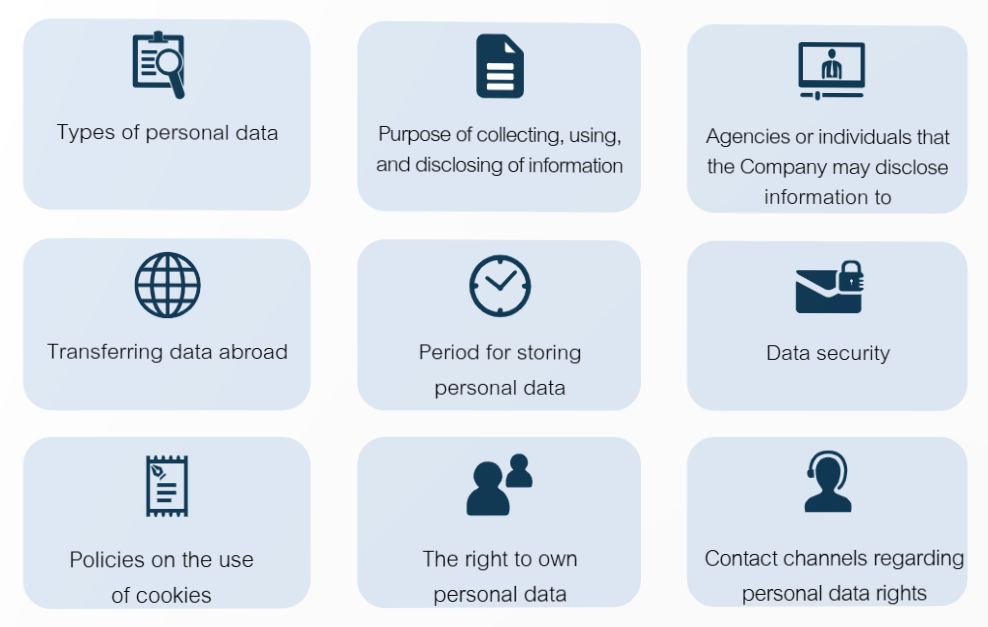
Code of Conduct
Introduction
The Board of Directors has established a Code of Conduct for business operations, which comprises principles and best practices to guide all directors, executives, and employees in performing their duties and conducting business, ensuring they are aware of and adhere to it. This is in line with good corporate governance principles and emphasizes respecting the rights of and treating all stakeholder groups equally, fairly, transparently, and accountably. The Company places importance on continuous personnel development in terms of knowledge, capabilities, ethics, and morality, and instilling a consciousness in its personnel to be honest, diligent, patient, and responsible. The Board of Directors and executives must be leaders in ethical matters and set an example in performing their duties with honesty, integrity, fairness, transparency, and accountability, in accordance with the Company's Code of Conduct for business operations.
Has a Business Code of Conduct
Yes
Code of Conduct Description
The Company is committed to growing its business by adhering to the principles of corporate governance to ensure that the Company and its subsidiaries operate efficiently in a fair, transparent, virtuous manner, and be responsible to its stakeholders, society, and the environment. It is also committed to developing the business to grow continuously and create value for all stakeholder groups and society as a whole in accordance with the Good Corporate Governance Policy. In this regard, the Company has established the Code of Conduct and Corporate Governance and Code of Conduct Handbook, which the Company’s directors, executives, and employees, must acknowledge and adhere to as guidelines for their work.
1. Shareholders
The Company and its employees will conduct its business operations with transparency, prudence, honesty, fairness and efficiency, in order to create sustainable value for the business. It also strives to create good operating results and stable growth to provide maximum benefit to its shareholders in the long run, including disclosing accurate and complete information within the time period specified by relevant laws or regulations with transparency and reliabil ity, to the shareholders. Additionally, the Company will not be involved in any illegal activities which violates or diminishes the rights of its shareholders, as well as treating all of its shareholders fairly and equally through the transparent disclosure of reliable information through the Company’s website, investors’ relations. The Company’s employees must not seek benefit from inside information that has not been disclosed to the public as a result of their position, duties and responsibilities, as it is considered taking undue advantage of its shareholders.
2. Employees
The Company will, without prejudice, establish an employee recruitment and selection process by taking into consideration their knowledge, capabilities, as well as their suitability for the position and the organization. The Company will also evaluate performance and consider remuneration and welfare benefits of its employees on an equal and fair basis, by taking into consideration their knowledge, capabilities, and respective performance, in conjunction with maintaining their work environment by taking into account the quality of life and work safety, while also strictly adhering to the related labor laws. Additionally, the Company places importance on the development of skills, knowledge, capabilities, and employees’ potential, by providing regular training and seminars, as well as equal opportunities, to create incentives for employees with high potential and capabilities to remain and further help develop the Company. Moreover, the Company provides channels for filing complaints if employees feel that they are not being treated fairly according to the Company’s established system and processes. Employees are also protected against bullying, or receiving any punishment if their complaints are made in good faith.
3. Customers
The Company is responsible to its customers by maintaining the quality and standards of products and services and ensuring the appropriate pricing of its goods and services. It also includes focusing on developing and maintaining sustainable relationships by responding to customer needs as completely and comprehensively as possible to ensure long-term customer satisfaction. Moreover, the Company also considers providing accurate and complete information regarding its products and services to customers and also encourages the use of innovations and research to develop quality products and services, and respond to customer needs across more dimensions. Additionally, the Company focuses on environmentally friendly practices that use fewer resources, and save energy, while also can be recycled and reused, and has a long service life. In its policy to enhance customer satisfaction, the Company has provided channels for its customers to be able to report problems regarding unsuitable products and services to enable the Company to help resolve and prevent a recurrence of such issues in a timely manner. The Company has also established measures for maintaining customers’ confidential information to prevent the unauthorized use for the benefit of oneself or those involved, in addition to, policies on not accepting, demanding, or paying any benefits, which are indications of dishonest acts.
4. Partners
The Company has a process for selecting business partners by allowing them to compete based on equal information and selecting them fairly under the Company's transparent evaluation and selection criteria. Furthermore, the Company has developed appropriate contract templates that comply with the law and are fair to all contracting parties, and has established a monitoring system to ensure full compliance with contractual terms and to prevent corruption and misconduct at every stage of the procurement process. The Company purchases goods from business partners according to commercial terms and strictly adheres to contracts with business partners without soliciting or accepting assets.
The Company will not conduct business with individuals or entities that commit illegal acts, engage in corruption, or violate human rights.
5. Creditors
The Company will comply with the various conditions as stipulated in the contract with its creditors, including making payments of the principal, interest, and maintenance of various collaterals, under the conditions of the relevant contract. Additionally, the Company will not employ dishonest means to conceal information or facts which may cause damage to creditors. In the event that the Company is unable to comply with any one of the conditions, the creditors will be notified in advance so that consideration may be jointly conducted to find solutions.
6. Competitors
The Company will conduct itself according to the rules of good competition by not seeking confidential information of its competitors through dishonest or inappropriate means and will conduct itself ethically within the framework of the law. Additionally, the Company supports and promotes free and fair competition without violating intellectual property rights or gaining trade secrets of its competitors through fraudulent means. The Company places great emphasis on conducting business ethically for all parties based on processes that are transparent, verifiable, and free from corruption. In 2025, there were no reports of disputes or lawsuits between the Company and its competitors.
7. Society and the Public
The Company prioritizes safety for society, the environment, and the quality of life of people involved in its operations. It encourages employees to develop a sense of responsibility for the environment and society, and to use modern and environmentally friendly technology to reduce wasted resources. The Company ensures strict compliance with various laws and regulations. It participates in environmental and societal care activities, and promotes local culture. The Company adapts its operating procedures to mitigate impacts on the environment, the community, and society.
Code of Conduct Link
https://www.moshimoshi.co.th/en/corporate-governance/policies-charters-and-corporate-documents
Code of Conduct Practices
| Guideline | Other — Please Specify | Detail | Document Link | ||||||||||||
|---|---|---|---|---|---|---|---|---|---|---|---|---|---|---|---|
| Prevention of Misuse of Inside Information | The Company has established a Conflicts of Interest Prevention Policy and Guidelines Conflicts of Interest. All directors, executives, and employees of the Company must acknowledge and comply with this policy. The Board of Directors shall consider and approve the policy for implementation and review it at least once a year. Communication shall be provided to executives and employees at all levels, starting from the new employee orientation process. The policy is based on the principle that any decision to enter into transactions or any other dealings of the Company must be for the utmost benefit of the Company and its shareholders. Actions that may lead to conflicts of interest should be avoided. The Company has guidelines on conflicts of interest with the following key principles: 1. All of the Company’s directors and executives, according to the Securities and Exchange Commission’s definition, and that of related persons, must report their interests and conflicts of interest that are related to the management of the Company, when taking office for the first time, and report every time there is a change in information regarding vested interests according to the form approved by the Board of Directors to the Chairman of the Audit Committee. 2. The Company has a clear and transparent shareholding structure with no cross shareholdings between major shareholders. Therefore, it does not cause any conflict of interest to any party. The Company’s and its subsidiaries’ shareholding structure has been disclosed in the Annual Registration Statement/Annual Report Form 56-1 One Report in detail, including the complete disclosure of securities holdings by the Board of Directors. 3. The Company has established a clear separation of duties and responsibilities between the Board of Directors, the Executive Committee, senior executives/management, and shareholders, thus making it free from interference of responsibilities. In the case that any Company director or executive has a vested interest in the matter under consideration, the executive will refrain from attending the meeting or voting to ensure that the decision reached by the Board of Directors and the management was conducted fairly for the true benefit of its shareholders. 4. The Good Corporate Governance Policy and the Policy to Prevent Misuse of Insider Information are established in writing within the scope of operations and employee regulations, with clear penalties in cases where executives or employees employees disclosing company information to the public or using it for personal gain. 5. Establish policies and guidelines regarding conflicts of interest and connected transactions to consider the appropriateness of transactions that must be screened by the Audit Committee, and ensure compliance with the criteria of the Securities and Exchange Commission, the Capital Market Supervisory Board, and the Stock Exchange of Thailand. 6. Require that directors, executives, or employees, who have interests related to the Company’s operations must not be involved in considering or approving such transactions, as well as ensuring that the price is set appropriately and fairly according to the general trading conditions as if conducting transactions with the general public. 7. Require that related party transactions be presented to the Audit Committee for consideration and opinion before being submitted for approval to the Board of Directors, in accordance with corporate governance principles and the criteria set by the Securities and Exchange Commission and the Stock Exchange of Thailand. 8. Require disclosure of information on transactions that may have conflicts of interest, or related parties’ trans actions, or cross-transactions, in accordance with the regulations of the Securities and Exchange Commission and the Capital Market Supervisory Board, and disclosed in the Annual Registration Statement/Annual Report Form 56-1 One Report or any other report, as the case may be, prioritizing the best interests of the shareholders. 9. Employees and their families are to refrain from being involved in any activities that conflict with the Company’s interests. Whether it is from contact with those involved in the business, such as business partners, customers, and competitors, or from using opportunities or information gained from being an employee for personal gains. It also involves the matter of conducting business that competes directly with the Company or being involved in work other than the Company’s work which affects the work performance of the employee. 10. Reporting Conflicts of Interest (1) Directors - Prepare a Certificate of Related and Conflict Person when assuming a new position, or when their information has changed, as the case may be. - Prepare a report according to the Conflict of Interest Report form and present it to the Audit Committee, regularly in December of each year, or when assuming a new position, or when conflicts occur during the year, as the case may be. - In the case in which the director is involved in an act that is considered a conflict of interest, the director will be required to reveal the facts to Audit Committee. (2) Executives, or a level that is equivalent to an “executive” - Prepare a Certificate of Related and Conflict Person when assuming a new position, or when their information has changed, as the case may be. - Prepare a report according to the Conflict of Interest Report form and present it to the Audit Committee, regularly in December of each year, or when assuming a new position, or when conflicts occur during the year, as the case may be. - For cases where an executive, or a level that is equivalent to an “executive” is involved in an act that is considered a conflict of interest, the executive will be required to disclose the facts to the Audit Committee. (3) Employees, from the level of assistant director up to the director, or its equivalent - For cases where employees from the level of assistant director level up to the director, or its equivalent, are involved in an act that is considered a conflict of interest, the “employee” must immediately disclose the facts to their respective supervisor, as soon as they possibly can, along with filling out the conflict of interest reporting form. - Supervisors are responsible for reviewing conflicts of interest. - In case of a conflict of interests, the supervisor will consider the issue and give orders, as well as reporting on the matter and presenting such to the Executive Committee, while also informing the employee of the decision and withdrawing from such activities. - Once the Executive Committee has considered the issue, the matter will be forwarded to the Human Resources Department for further action. | https://www.moshimoshi.co.th/en/corporate-governance/policies-charters-and-corporate-documents | |||||||||||||
| Anti-corruption | The Company is aware of the importance of battling corruption and is fully committed to conducting its business with ethics under the framework of good corporate governance and principles of ethical conduct. It is also committed to being responsible to society, the environment, and all of its stakeholders. In this regard, the Company has established an anti-corruption policy and guidelines in writing by proposing it to the Board of Directors to consider promulgating. Communication of the policy is targeted to employees at all levels, starting from the orientation process for new employees. It is also comprehensively communicated within the organization to prevent fraud and corruption in all of the Company’s business activities and ensure that decisions and business operations that may be at risk of corruption are carefully considered and practiced. The policy covers matters regarding donations to charities, activities for public benefits, supporting political parties, financial support, facilitation payments, hiring government officials, conflicts of interest, providing gifts or services, as well as entertainment and hospitality services. The Company declared its intention to participate in the Thai Private Sector Collective Action Against Corruption (CAC) on February 28, 2024, and the Company was certified on September 30, 2025. | https://www.moshimoshi.co.th/en/corporate-governance/policies-charters-and-corporate-documents | |||||||||||||
| Whistleblowing and Protection of Whistleblowers | The company has established a Whistleblowing Policy to protect and ensure fairness to individuals who report or disclose information regarding wrongdoing, corruption, non-compliance with laws, regulations, company and subsidiary regulations, policies, and various practices, such as Human Rights Policy and Code of Conduct. The details can be summarized as follows: Whistleblowers All personnel of the company and its subsidiaries at all levels, as well as all stakeholder groups such as shareholders, customers, business competitors, creditors, government, communities, society who encounter the company’s or its subsidiaries’ personnel committing corruption related to the company or subsidiaries, violating laws, rules, regulations, company’s and subsidiaries’ directives, policies, and company practices, or persons who are treated unfairly resulting from their complaints, providing information, reporting clues, cooperating, assisting in investigation procedures, fact-finding, being witnesses, giving statements, or any other cooperation to the court or government agencies. The subjects of complaints 1. Non-compliance with laws, including the Securities and Exchange Act, the Company’s regulations, policies, and practices of the Company. 2. Acts of corruption within the Company and its subsidiaries, whether direct or indirect, such as encountering individuals within the organization who are involved in bribery or receiving bribes from government officials, or private organizations. 3. Violations of the procedures and practices of the Company and its subsidiaries, inaccuracies in f inancial reporting, or deficiencies in the internal controls of the Company and its subsidiaries that raise suspicions of potential avenues for corruption or harm to the Company or its subsidiaries. Whistleblowing channels Complainants can file complaints or report clues and must specify the details of the complaint or whistleblowing along with the name, address, and telephone number that can be contacted to the following channels: 1. In the event that the accused person holds a position lower than the Chief Executive Officer The complaint shall be reported to the Executive Committee through the Chief Executive Officer via the following channels: 1.1 Email: moshiwhitleblower@moshimoshi.co.th 1.2 Postal mail to: No. 129 The Mall Thapra Building, 9th Floor, Ratchadapisek Road, Bukklalo Sub-district, Thonburi District, Bangkok 10600 1.3 Website: www.moshimoshi.co.th 2. In the event that the accused person holds a position higher than the Chief Executive Officer The complaint shall be reported to the Audit Committee through the Chairman of the Audit Committee via the following channels: 2.1 Email: ac@moshimoshi.co.th 2.2 Postal mail to: No. 129 The Mall Thapra Building, 9th Floor, Ratchadapisek Road, Bukklalo Sub-district, Thonburi District, Bangkok 10600 2.3 Website: www.moshimoshi.co.th In this regard, complaints will be treated with the utmost confidentiality, and complainants can file complaints or report concerns through more than one channel. There is no requirement to disclose the complainant’s identity unless self-disclosure is necessary for the company to communicate the results or provide additional details regarding the complaint. Fact-Finding Procedures and Penalties 1. In conducting investigations and gathering facts, the recipient of the complaint shall propose the complaint to the following individuals to act as investigators and fact-gatherers, as per the complaint received. A. In cases where the subject of the complaint is an individual holding a position lower than the Chief Executive Officer, the Executive Committee and/or an individual or unit assigned by the Executive Committee shall act as the investigator. B. In cases where the subject of the complaint is an individual holding a position higher than the Chief Executive Officer, the Audit Committee and/or an individual or unit assigned by the Audit Committee shall act as the investigator. In this case, the investigator may invite any employee to provide information or request the submission of any relevant documents for fact-finding. If the investigator is an individual or unit assigned by the Audit Committee or the Executive Committee, such individual or unit shall report the investigation results back to the Audit Committee or the Executive Committee (on a case-by-case basis). 2. If there are reasonable grounds to believe that the subject of the complaint has indeed committed an offense, the subject of the complaint will be informed of the allegations and have the right to prove their innocence by providing additional information or evidence demonstrating no involvement in the alleged misconduct. 3. If the investigation reveals that the complaint is true, the Company will proceed as follows: A. Offenders will be subject to disciplinary action as prescribed by the Company's regulations, and if the corrupt act is illegal, offenders may also face legal penalties. B. In cases where the complaint is significant, such as one affecting the Company's reputation, image, or financial standing, the Company's financial matters, conflict with the Company's business operating policies, or involve senior management, etc., the investigator shall consider submitting the matter with their opinion to the Board of Directors for further consideration. C. In cases where a complaint causes harm to an innocent party, the investigator may propose appropriate and fair methods of relief to the injured party as deemed fit. Measures for Protecting Information Providers or Whistleblowers 1. Complainants may choose not to disclose their identity if they believe that disclosure could cause them harm, but they must provide sufficient factual details or clear evidence to demonstrate reasonable grounds to believe that there has been an act of corruption or a violation of laws, regulations, company rules, practices, or business ethics principles. 2. Information related to complaints or whistleblowing, including the names of information providers or whistleblowers, is considered confidential by the Company and will only be disclosed as necessary, taking into account the safety and potential harm to the information provider, whistleblower, and related individuals. The complaint recipient, investigator, and all personnel involved in every step must maintain the highest level of confidentiality for the information received and not disclose it to others. Violation of this will be considered a disciplinary offense. 3. The Company will not demote, punish, or take any negative action against complainants or employees who refuse corruption, even if such actions result in the Company losing business opportunities. 4. Those who have suffered harm will receive appropriate and fair relief through suitable methods or processes. 5. The Audit Committee, the Executive Committee, or an assigned individual may consider increasing protection measures for complainants, whistleblowers, or those cooperating in investigations as deemed appropriate, if it is perceived that there is a likelihood of harm or insecurity to such individuals arising from the complaint or whistleblowing in accordance with the policy. 6. Employees who treat others unfairly, discriminate inappropriately, or cause harm to others, motivated by the fact that such others have filed complaints, provided information, or blown the whistle on corruption or non-compliance with laws, regulations, rules, policies, and various practices of the Company, including those who have filed lawsuits, acted as witnesses, given statements, or cooperated in any way with courts or government agencies, shall be considered to have committed a disciplinary offense and shall be subject to penalties, and may also be subject to penalties as prescribed by law if the act constitutes a legal offense. The Company has clear operating procedures for fact-finding in accordance with its whistleblowing policy regarding misconduct and its business ethics principles. | https://www.moshimoshi.co.th/en/corporate-governance/policies-charters-and-corporate-documents | |||||||||||||
| Preventing the Misuse of Inside Information | The Company places importance on preventing the use of inside information in compliance with laws and good corporate governance principles. This is stipulated in writing in the Good Corporate Governance Policy, the Code of Conduct, the Policy to Prevent Misuse of Insider Information, and Guidelines Prevent Misuse of Insider Information and Securities Trading. All directors, executives, and employees must acknowledge and adhere to these. The policies are proposed to the Board of Directors for approval and implementation, reviewed at least once a year, and communicated to all executives and employees. The Company's policy on preventing the use of inside information and guidelines for the use of inside information and securities trading prohibit directors, executives, and employees of the Company from using any information that may affect the price of the Company's securities, or information that, if disclosed, would cause damage or disadvantage to the Company. Such information is considered confidential and important. This also includes not disclosing or seeking benefits for themselves or others, whether directly or indirectly, and regardless of whether compensation is received, from confidential and/or inside information of the Company that has not yet been disclosed to the public. Furthermore, they must not trade the Company's securities using inside information. The Company has established guidelines for preventing the use of inside information and securities trading. 1. To provide education to the Company's directors and executives regarding their duty to report their own, their spouse's or cohabiting partner's, and their minor children's securities holdings to the Securities and Exchange Commission in accordance with Section 59 and the penalties under Section 275 of the Securities and Exchange Act B.E. 2535 (1992) (including any amendments thereto), as well as the reporting of the acquisition or disposal of securities by oneself, spouse or cohabiting partner, and minor children to the Securities and Exchange Commission in accordance with Section 246 and the penalties under Section 298 of the Securities and Exchange Act B.E. 2535 (1992) (including any amendments thereto). 2. To require the Company's directors and executives, as well as their spouses or cohabiting partners, and minor children, to prepare and disclose reports on their securities holdings and changes in securities holdings of the Company to the Securities and Exchange Commission in accordance with Section 59 of the Securities and Exchange Act B.E. 2535 (1992) (including any amendments thereto) and deliver a copy of this report to the Company on the same day as the report is submitted to the Securities and Exchange Commission. The said changes shall be reported to the Board of Directors' meeting and disclosed in the Annual Registration Statement/Annual Report Form 56-1 One Report. 3. To require the directors, executives, and employees of the Company who have received material inside information that has or may have an impact on the change in securities prices to refrain from trading the Company's securities for at least thirty (30) days before such financial statements or inside information are disclosed to the public, and during the period 24 hours after such information of the Company has been disclosed to the public, and those involved with such information must not disclose it to others until such information has been reported to the Stock Exchange of Thailand. The Administration Department (Company Secretary) will send an email to relevant individuals to inform them of the period Blackout Period in advance, and in 2025 It was not found that directors, executives, or relevant employees traded securities during the period when the Company prohibited trading. 4. Directors, executives, and employees of the Company are prohibited from using inside information of the Company that has or may have an impact on the change in the price of the Company's securities, which has not yet been disclosed to the public, and which they have become aware of in such position or capacity, for the purpose of buying or selling, or offering to buy or sell, or soliciting others to buy or sell, or offering to buy or sell shares or other securities (if any) of the Company, whether directly or indirectly, which may cause damage to the Company, and regardless of whether such action is for their own benefit or the benefit of others, or whether they disclose such facts to enable others to perform such actions with or without receiving benefits in return. 5. In the event of any violation of the aforementioned guidelines, the Company will consider it a disciplinary offense under the Company's work regulations and will impose appropriate penalties, which may also include criminal and civil liability under the Securities and Exchange Act. | https://www.moshimoshi.co.th/en/corporate-governance/policies-charters-and-corporate-documents | |||||||||||||
| Giving or receiving gifts, entertainment, or business entertainment | Guidelines for Giving or Receiving Gifts, Assets, or Other Benefits In order to uphold its anti-corruption and anti-bribery policy, corporate governance policy, and business ethics, the company has established the following guidelines for giving and receiving gifts, souvenirs, or other benefits.
However, the aforementioned individuals may receive and give gifts or other benefits under the following circumstances: (1) To conduct operations correctly, with full disclosure and transparency, in a manner consistent with moral principles, and in compliance with applicable laws, the Company’s regulations, as well as the rules and requirements of government agencies, state enterprises, public organizations, and other relevant authorities. (2) Appropriate to the circumstances, occasions, and local traditions and customs. (3) Not used as a pretext for fraud or corruption. (4) Not giving rise to any conflict of interest between personal interests and the interests of the Company. (5) The value of gifts given or received, entertainment, hospitality, services, or any other benefits shall not exceed THB 3,000 per occasion when dealing with government agencies or government officials. However, if the aforementioned individuals give or receive gifts, money, assets, items, entertainment, travel expenses, or other benefits, they must cooperate in preparing a “Gift, Asset, or Other Benefit Receipt Report Form" and “Gift, Asset, or Other Benefit Request/Report Form,” and report to their direct supervisor, with a copy to the Administration Office. 1. The Giving of Gifts, Assets, or Other Benefits 1.1 The giving of gifts, assets, or other benefits shall be conducted in accordance with customary practices and social norms, including occasions for extending congratulations, expressing appreciation, providing hospitality, offering condolences, or rendering assistance as a matter of courtesy commonly observed in society. Such giving may be carried out provided that it does not violate applicable laws and local customs. For example, the value shall not exceed THB 3,000 per person per occasion, and the gift should be in a form that enhances the image of the Company and its group companies, as follows: A. Calendars, Diaries B. Products of the Company and its group companies (Company Product) C. Products used as promotional materials for the Company and its group companies (Corporate Logo / Corporate Brand) D. Products from Royal Projects, Royal Initiative Projects, community products from areas in which the Company and its group companies operate, or products for charitable or public benefit purposes, or products that support sustainable development. 1.2 Gifts, assets, or other benefits shall be given in the name of the Company only, and not in the name of any director, executive, or employee, and shall be provided in an open and transparent manner, without concealment. 1.3 The giving of gifts, assets, or other benefits should be carried out in a consistent and standardized manner to avoid discrimination or preferential treatment. 1.4 Gifts, assets, or other benefits shall be appropriate in type and value and consistent with proper etiquette and circumstances. For example, during a bidding or tender process, the giving of gifts to government officials, as well as directors, executives, and employees of the relevant companies or agencies, shall be strictly prohibited. 1.5 Gifts, assets, or other benefits shall not be given to spouses, children, or related persons of government officials, customers, business partners, or other contact persons, as such acts may be deemed, by their nature, to constitute indirect receipt on behalf of such persons. 1.6 The giving of gifts, assets, or other benefits in accordance with customary practices and social norms, including occasions for extending congratulations, expressing appreciation, providing hospitality, offering condolences, or rendering assistance as a matter of social courtesy, as well as on significant business occasions such as anniversaries of establishment or the signing of business agreements, may be permitted. The value of such gifts or souvenirs should not exceed THB 3,000. If the value exceeds THB 3,000, the responsible unit shall complete the “Gift, Asset, or Other Benefit Approval/Reporting Form” and attach supporting documents for consideration, such as quotations and photographs/images of the gifts, and submit them for approval in accordance with the Company’s anti-corruption practices and guidelines. 1.7 For expense reimbursement, Company regulations regarding authorized approvers for budget disbursements must be followed, along with attached documents such as the approved "Gift, Asset, or Other Benefit Request/Report Form", and supporting expense documents or other evidence within 7 business days after the operation, and all documents must be submitted to the Accounting and Finance Department for retention as evidence for future inspection, with a copy provided to the Administration Office. 2. Receipt of Gifts, Assets, or Other Benefits 2.1 Establish a "No Gift Policy" announcement during various festivals, such as New Year's, or other occasions, to set a good standard for business operations. Company personnel are responsible for continuously informing business partners and relevant stakeholders about the Company's No Gift Policy and requesting their cooperation in its implementation. 2.2 Company personnel are prohibited from accepting gifts, assets, or any other benefits in all cases where there is an improper intention or an impact on decision-making for personal gain, and have a duty to thoroughly inform external parties about the anti-corruption policy. 2.3 In cases where it is necessary to accept gifts, assets, or other benefits, and it cannot be avoided or returned, the following must be observed: A. The recipient must report to their line manager and record the receipt in the “Gift, Asset, or Other Benefit Receipt Report Form,” and hand over the item to the Administration Office. B. The Administration Office must record the receipt and is responsible for collecting such items and taking appropriate action, such as using them as rewards for employees during important festivals, or seeking approval to donate them to external individuals or organizations for charitable or public benefit as deemed appropriate, unless 1. In the case of perishable goods with an expiration date of less than 1 month, it is at the discretion of the supervisor of the department receiving the gift to manage it. It may be distributed within their own department or shared with other departments, by preparing a “Gift, Asset, or Other Benefit Receipt Report Form” for the Company's acknowledgment. 2. In cases where items such as pens, calendars, or diaries are used as promotional materials for the Company, employees may receive them as personal gifts or distribute them to other departments without having to prepare a “Gift, Asset, or Other Benefit Receipt Report Form” for the Company's acknowledgment. 3. In cases of receiving gifts or souvenirs on behalf of an organization from another organization, such as during the signing of a business contract, these may be accepted. Such gifts or souvenirs must become the property of the Company. The recipient must prepare a “Gift, Asset, or Other Benefit Receipt Report Form” and have it approved by their line manager, then submit the gift to the Administration Office. Guidelines for Hospitality and Entertainment The Company recognizes the importance of maintaining good relationships with its stakeholders. Therefore, expenses for business entertainment, such as food and beverage hospitality, sports-related entertainment, various recreational activities, and other expenses directly related to business operations or customary trade practices, including providing business knowledge and understanding, are permissible. However, such expenses must be reasonable and must not affect the operational decisions of the recipient or create conflicts of interest between the Company, the recipient, or related third parties. All incurred expenses must comply with the Company's approval authority. The Company has thus established the following guidelines for entertainment and hospitality services: 1. Expenses for business entertainment and hospitality services, such as food and beverage hospitality, sports-related entertainment, and other expenses directly related to business operations or customary trade practices, including providing business knowledge and understanding, are permissible. However, such expenses must be reasonable and must not affect operational decisions or create conflicts of interest. 2. must be entertainment or hospitality services provided solely in the name of the Company, not in the name of directors, executives, or employees, and must be conducted openly and not concealed. 3. must be of an appropriate type and value, and suitable for the occasion. For example, during a bidding process, providing services or entertainment to government officials, directors, executives, and all employees of the company or related agencies is prohibited. 4. must not involve entertainment or hospitality services in inappropriate venues. 5. must not be an act to influence, induce, or reward any person to gain an advantage through improper or hidden actions to obtain assistance or benefits. 6. For entertainment or hospitality services, a memo must be attached to the “Entertainment or Hospitality Service Request/Report Form” and submitted for approval consideration according to the authorized approval limits and anti-corruption guidelines. 7. Expense reimbursement must comply with Company regulations and authorized procedures. The requester must provide supporting documents for expense reimbursement, including the approved "Entertainment or Hospitality Service Request/Report Form", along with supporting expense documents within 7 business days after the operation, and all documents must be submitted to the Accounting and Finance Department for retention as evidence for future inspection. Guidelines for Donations, Sponsorships, and Goods for Donation The Company has guidelines for donations, sponsorships, and goods for donation, which must be transparent, lawful, and verifiable as being used for charitable purposes or genuine support according to the approved objectives. They must comply with laws and not contradict morality, and must not be used as an excuse for bribery or corruption, or to create undue business advantages. Furthermore, providing financial support for various projects must aim to benefit the business, enhance its positive image, and reputation. Therefore, the following guidelines for donations and sponsorships are established: 1. Donations, whether in the form of financial assistance or other forms such as providing knowledge or time, etc., can be made by the Company as part of its corporate social responsibility activities, as well as for public relations and enhancing the Company's positive image, without aiming for business returns. Donations and sponsorships must be carried out under the following conditions: 1.1 must be transparent, lawful, and not contradict morality, and must not involve any actions that could be used as an excuse for bribery or corruption, or to create undue business advantages. 1.2 must be a credible organization and/or legally established. 1.3 must be a donation, made in the name of the Company only. 1.4 must have clear objectives for the donation, which can be implemented and evaluated. 1.5 Money should not be paid directly to any official or individual in their personal capacity, unless explicitly detailed in the support request letter and supported by written evidence of receipt. 1.6 For all donation activities, the requesting unit shall submit a “Donation, Sponsorship, and Goods for Donation Report Form” together with relevant supporting documents, such as a formal donation request letter, for review and approval in accordance with the Company’s Anti-Corruption Policy, procedures, and applicable internal controls. 1.7 The reimbursement of donation expenses (in the case of cash donations) shall be carried out in accordance with the Company’s policies, procedures, and delegated authority. The reimbursement requester must provide supporting documentation, including the approved “Donation, Sponsorship, and Goods for Donation Report Form”, together with relevant expense reimbursement documents, to the Accounting and Finance Department for recordkeeping and audit purposes. 1.8 Upon completion, the applicant must prepare a “Donation, Sponsorship, and Goods for Donation Report Form” along with evidence of the donation, such as photographs, acknowledgment letters, or receipts in the case of monetary donations, and submit all documents within 7 business days after the operation, and all documents must be submitted to the Accounting and Finance Department for retention as evidence for future inspection. 1.9 Monitoring and inspection should be conducted to ensure that donations and/or sponsorships are genuinely used for public benefit and/or align with the true objectives of the donation and/or sponsorship, without hidden agendas or for obtaining undue business advantages. 2. Providing financial support, whether money or assets, to any activity or project must be conducted transparently, lawfully, and with assurance that such support will not be used as a means to avoid bribery. Furthermore, financial support must aim to advertise, promote, and enhance the business image and positive reputation of the Company, without expecting benefits or having hidden corrupt or improper objectives. This may take various forms, such as supporting cultural activities, social and environmental activities, educational endeavors, and sports, etc. 2.1 Corporate Social Responsibility (CSR) activities can be conducted both internally and externally, taking into account all stakeholders, from shareholders, employees, customers, creditors, competitors, government, community and society, as well as the environment. Such activities must have clear objectives. 2.2 Monetary support or Corporate Social Responsibility (CSR) activities must not involve reciprocal benefits for any specific individual, agency, or group of individuals. 2.3 Monetary support or Corporate Social Responsibility (CSR) activities must be auditable, with clear receipts or other supporting documents consistent with Company regulations, to ensure that such support is not used as an excuse for corrupt practices. 2.4 Corporate Social Responsibility (CSR) activities or any activities conducted in the Company's name must exclude activities related to supporting political parties. 2.5 For providing financial support, the department responsible for providing the support must prepare a “Donation, Sponsorship, and Goods for Donation Request Form” and attach supporting documents for approval, such as a support request letter, and submit it for approval consideration in accordance with the anti-corruption guidelines. 2.6 The process for reimbursing sponsorship expenses must comply with Company regulations and authorized procedures, along with attached documents. The requester must provide supporting documents for the sponsorship reimbursement, including the approved "Donation, Sponsorship, and Goods for Donation Request Form", along with supporting expense documents to the Accounting and Finance Department. 2.7 Upon completion, the applicant must prepare a “Donation, Sponsorship, and Goods for Donation Report Form” along with evidence of the sponsorship, such as photographs, acknowledgment letters, within 7 business days after the operation, and submit all documents to the Accounting and Finance Department for retention as evidence for future inspection. 3. Donated Goods The Company may engage in donating goods as part of its corporate social responsibility activities, as well as for public relations and enhancing the Company's positive image, without aiming for business returns. Donated goods must be carried out under the following conditions: 3.1 Must be transparent, lawful, and not contradict morality, and must not involve any actions that could be used as an excuse for bribery or corruption, or to create undue business advantages. 3.2 Must be a credible organization and/or legally established. 3.3 Must be a donation of goods, made solely in the name of the Company. 3.4 For donating goods, the department responsible for the donation must prepare a “Donation, Sponsorship, and Goods for Donation Request Form” and attach supporting documents for approval, such as a donation request letter, and submit it for approval consideration in accordance with the anti-corruption guidelines. 3.5 The process for requesting donated goods must comply with the authorized procedures. The requester must provide supporting documents for the request of donated goods, including the approved "Donation, Sponsorship, and Goods for Donation Request Form", along with details of the goods to be donated, and submit them to the Product Sourcing and Development Department. 3.6 Upon completion, the applicant must prepare a “Donation, Sponsorship, and Goods for Donation Report Form” along with evidence of the donation, such as photographs, acknowledgment letters, and submit all documents within 7 business days after the operation, and all documents must be submitted to the Accounting and Finance Department for retention as evidence for future inspection. | ||||||||||||||
| Compliance with laws, rules and regulations | The Company places importance on compliance with laws, regulations, rules, operational procedures, and various criteria relevant in all areas where business is conducted, including respecting cultural differences and local customs and traditions. Company personnel must study, understand, respect, and not violate laws, act correctly and fairly towards all parties, and not commit any acts that contradict those cultures and customs and traditions, as well as report complaints and provide information when observing violations or non-compliance with laws. 1. Company personnel must thoroughly study and understand the laws, customs, traditions, and cultures of each area, as well as the regulations, rules, operational procedures, and various criteria directly related to their duties and responsibilities, and strictly adhere to them. This is to ensure that goods, product samples, equipment carried, travel documents, travel objectives, and operations do not violate laws or contradict customs, traditions, and cultures. If unsure, personnel must seek advice from their supervisor and are prohibited from acting based on their own understanding without guidance. 2. The Company respects the customs, traditions, and cultures of each locality where it invests, conducting business and complying with the laws in each relevant country or locality. It is always aware that laws, regulations, or customs and traditions in each locality may have different conditions, procedures, or practices. 3. Company personnel must not assist or support any actions that evade or violate compliance with laws, regulations, rules, operational procedures, and various criteria related to the Company's business operations. If it is found that the Company's regulations, requirements, operational procedures, or directives differ from those enforced in a particular area or country, relevant departments must be consulted before taking any action. In the past year, the Company has not been fined, accused, or subjected to civil proceedings. The Company places importance on compliance with laws, regulations, rules, operational procedures, and various criteria relevant in all areas where business is conducted, including respecting cultural differences and local customs and traditions. Company personnel must study, understand, respect, and not violate laws, act correctly and fairly towards all parties, and not commit any acts that contradict those cultures and customs and traditions, as well as report complaints and provide information when observing violations or non-compliance with laws. | ||||||||||||||
| Use and maintenance of data and assets | The protection of inside information is crucial for the Company's success and for the career stability of all personnel. To ensure that information provided to external parties does not harm the Company's business and reputation, guidelines for the use of inside information and securities trading, as well as a personal data protection policy, have been established. Company personnel must keep inside information confidential and must not use it for personal gain, even after their employment or duties have ceased. 1. Company personnel must safeguard internal information and documents that cannot be disclosed to external parties, which could lead to illicit personal gain for themselves, their families, or associates, such as information affecting stock prices, trade secrets, and various invention formulas, all of which are considered the Company's rights. 2. Personal data retained by the Company is collected correctly, kept confidential, and used in good faith as acknowledged and consented to by the data owner, and in compliance with relevant laws. Company personnel involved must strictly adhere to policies and/or procedures related to personal data. 3. Company personnel must not use confidential information for personal gain or for the benefit of others. 4. Company personnel who receive or work with personal data must store or use such data with caution. 5. The Company stipulates that information related to counterparties and agreements made with counterparties shall be considered confidential and may not be disclosed to any other person, unless explicit permission is obtained from both the Company and the counterparty. 6. The Company shall implement stringent measures and control systems for its data within each department or division to prevent critical internal Company information from being disclosed externally before official dissemination. These measures and control systems shall be considered an integral part of the Company's key risk control measures. 7. The Company assigns the duty and responsibility to supervisors at various levels to control and prevent the leakage of critical Company information and news to external parties by personnel under their command before the official dissemination of such information by the Company. 8. The shared use of inside information by personnel must be strictly within the scope of duties and responsibilities assigned to them. 9. Company personnel must not disclose confidential information of the Company, even after their employment or duties have ceased. 10. If asked or requested to disclose information outside of one's responsibility, politely decline to express any opinions and advise to inquire directly with the assigned and responsible unit for that information disclosure, to ensure accurate and consistent information provision. 11. The Company has established classifications for data confidentiality and methods that Company personnel must understand regarding the level of confidentiality and practices for maintaining secrecy. Company personnel must safeguard the confidentiality of information within their responsibility, preventing it from falling into the hands of others, including unrelated personnel from other companies. 12. The Company must maintain and protect customer information and trade secrets as confidential. Company personnel must not disclose customer secrets to other Company personnel or external personnel who are not involved, unless disclosure is mandated by law, for the purpose of litigation, or approved by the Board of Directors. 13. Inside information refers to data concerning the Company's operations and management, which is confidential and not yet disclosed to the public. Its disclosure would impact the Company, particularly affecting the value of its shares traded on the stock exchange. Therefore, Company personnel must keep inside information confidential and must not disclose inside information acquired through their duties to others, or use such information for illicit gain, or to diminish the Company's interests. Intellectual Property and Copyrighted Works The Company respects the intellectual property rights of others by not infringing upon or supporting actions that constitute infringement of others' intellectual property and copyrighted works. It conducts business fairly, respects, and complies with intellectual property laws. 1. The Company must conduct its business in compliance with laws, regulations applicable to its investments, and contractual obligations related to valid intellectual property rights, patents, copyrights, trade secrets, and other proprietary information. 2. The Company must not infringe upon or misuse valid intellectual property rights. 3. Company personnel responsible for maintaining trade secrets, confidential formulas, product manufacturing processes, or confidential business methods must safeguard such secrets with the utmost security and prevent any leakage of such information. 4. Company personnel must respect the intellectual property rights of others and shall not use any part of others' work for personal gain without prior authorization or compensation to the owner of the work. 5. Company personnel are obligated to comply with all laws and regulations concerning the protection of all types of intellectual property, as well as all contractual provisions and obligations related to the intellectual property rights of others, including patents, copyrights, trademarks, trade secrets, and proprietary information. 6. When entering into any contract or legal act, the intellectual property rights should be clearly agreed upon. 7. The transfer of the Company's intellectual property rights to any other person, whether or not they are part of the group company, must be carried out in accordance with legal requirements and must be executed solely by authorized personnel of the Company. 8. Report to supervisors or intellectual property managers upon observing any act that constitutes an infringement or an act that may lead to an infringement of intellectual property rights. 9. In the event that any copyrighted work or other intellectual property arises from the performance of duties by executives or employees, such copyrights or intellectual property shall belong to the Company. 10. Company personnel whose employment has ceased must return all intellectual property of the Company, such as inventions, reports, trade data, various programs, processes, and innovations, that are in their possession. In addition to establishing measures to prevent intellectual property law violations, the Company has developed products and possesses its own products. The Company protects its intellectual property to prevent infringement by others, and will proceed with registering intellectual property such as trademarks, patents, etc. | ||||||||||||||
| Anti-competitive | The Company is committed to conducting business fairly, adhering to ethical principles and good competition rules. The Company opposes unfair competition by not seeking confidential information of business competitors through dishonest or inappropriate means, not damaging the reputation of business competitors through malicious accusations, not entering into any agreements that restrict trade competition, and promoting free competition. The Company shall not engage in any actions that distort market prices, which would harm consumers, and shall cooperate to enhance business potential for sustainable growth. The Company shall treat business competitors in accordance with international principles under the framework of laws concerning fair competition practices, and shall not violate or gain knowledge of trade secrets of business partners through fraudulent means. The following guidelines shall be observed: 1. Treat business competitors equally and fairly, based on the principle of fair returns for both parties within the framework of competition rules. 2. Do not seek confidential information of business competitors through dishonest, inappropriate, or unlawful means. 3. Do not intentionally damage the reputation of business competitors through disparaging accusations without verifiable information. 4. Do not commit any acts that infringe upon the intellectual property and copyrighted works of others or business competitors. 5. Exercise caution in contacting and exchanging information with business competitors, as such actions may be perceived as violating trade competition laws and anti-monopoly laws. 6. Do not enter into any agreements with competitors or any individuals that would reduce or restrict trade competition, or that would constitute a trade monopoly in the relevant countries. | ||||||||||||||
| Cyber security | The Company prioritizes the confidentiality of various data, as it interacts with multiple parties such as customers, business partners, etc. Access rights to data and information systems are defined according to the authority and responsibilities of each employee level. Measures for maintaining information system security, such as data backup systems, are in place. The Company has assigned the Information Technology Department the responsibility of overseeing the Company's information systems and has established an Information and Cyber Security Policy, with key principles as follows: 1. Ensure that the company's information systems and information technology are secure, reliable, and equipped with measures to prevent, respond to, and mitigate risks from cyber threats, including data and personal data breaches, in compliance with laws and international standards. 2. Establish regulations, criteria, and guidelines for the use of the company's information systems and information technology to ensure information and cyber security. 3. Implement appropriate and secure access control measures for information systems and information technology, covering confidentiality, integrity, and availability. 4. Implement measures for preventing and monitoring cyber security threats in accordance with cyber security frameworks to protect against various threats that may impact the company's business operations. 5. Implement information backup, including measures and management, in the event of anomalies or cyber threats affecting information security, in an appropriate, rapid, and timely manner to control damage that could impact the company's business operations. 6. Implement assessment, analysis, and management of information and cyber security risks to identify preventive and corrective measures for potential risks, as well as to prevent various threats that may affect the company's business operations. 7. Regularly review regulations, criteria, guidelines, and various measures related to information and cyber security to ensure they are up-to-date and consistent with current situations, laws, international standards, and the company's business operations. 8. Oversee employees and relevant parties to strictly adhere to regulations, principles, guidelines, and various measures, as well as support implementation and public relations to foster a sense of responsibility and continuous awareness of the importance of information and cyber security. 9. Regularly review and revise the Information and Cyber Security Policy annually or whenever significant changes occur. The Company emphasizes responsible marketing communication and respects customer data rights, especially for public relations activities or communications via various social media platforms. The Company respects customer privacy and provides customers with the option to decline receiving news and information (Unsubscribe). Furthermore, the Company ensures that the content of the information is factual. Furthermore, the Company has the following measures for preventing and managing cyber security risks: 1. Implement screening and assign specific access rights to relevant personnel for accessing, distributing various data, and backing up data. 2. Install systems and equipment for threat prevention and threat behavior monitoring. Attack reports and remediation results are prepared to serve as data for developing future preventive measures. 3. Conduct penetration testing (Penetration Testing) and Vulnerability Assessment to ensure that systems are secure and can effectively prevent threats. 4. Continuously raise cyber security awareness among employees regarding threats, prevention methods, and relevant IT laws, covering all internal communication channels of the company. Training and performance measurement are also provided for continuous improvement. 5. Continuously provide knowledge on information technology system security and management, including instilling awareness among employees about the importance of Cyber Security systems. This involves creating educational materials and enhancing understanding through email and Tech Talks to ensure all employees have comprehensive access to information. 6. Establish a Cyber Incident Response Plan to enable rapid response and system recovery, thereby minimizing impact on the company's operations and critical data. Cyber Security Statistics
| https://www.moshimoshi.co.th/en/corporate-governance/policies-charters-and-corporate-documents | |||||||||||||
| Environmental management | The Company is committed to developing, upgrading, and enhancing the efficiency of its operations and other activities throughout its value chain to manage various environmental issues with which the Company is involved, ensuring operations align with the Company's sustainable development policy and the Sustainable Development Goals (SDGs) 1. The Company adheres to and complies with national laws, environmental regulations, and standards recognized at both industrial and national levels, including environmental management measures related to the Company's operations, ensuring full compliance and performance within specified criteria. 2. The Company promotes and supports sustainable supply chain management, as well as the procurement of environmentally friendly products and services, including environmental innovations that can help reduce environmental impacts and meet greenhouse gas (GHG) reduction targets. It also promotes the use of clean energy, energy conservation, and efficient resource utilization to reduce greenhouse gas emissions and contribute to addressing climate change. 3. The Company focuses on reducing resource consumption by implementing the 3R concept (Reduce – Reuse – Recycle) in its operations. 4. The Company promotes sustainable sourcing of related goods and materials, including environmentally friendly products in collaboration with manufacturers, to foster sustainable resource management practices. 5. The Company manages and enhances the efficiency of environmentally friendly transportation and distribution of goods. 6. The Company promotes awareness among all employees to consider and account for environmental impacts and to participate in preventing adverse effects on natural resources and the environment. | https://www.moshimoshi.co.th/en/corporate-governance/policies-charters-and-corporate-documents | |||||||||||||
| Human rights | The Company recognizes the importance of respecting human rights as a fundamental basis for conducting business. Therefore, the Company has established a human rights policy as a commitment to adhere to, support, and promote the respect and protection of the fundamental rights and human dignity of everyone involved in the Company's operations, in accordance with domestic laws, Universal Declaration of Human Rights (UDHR), the principles of the United Nations Global Compact (UNGC), United Nations Guiding Principles on Business and Human Rights (UNGPs), and the Declaration on Fundamental Principles and Rights at Work of the International Labour Organization (ILO), with key principles concerning the protection of rights, respect for rights, and remediation when human rights violations occur due to business operations. By establishing a unified human rights policy across the organization, the Board of Directors mandates that all directors, executives, and employees of the Company must adhere to and acknowledge it, as well as communicate it to All stakeholder groups, including business partners be informed as well. Scope The Company considers adopting a human rights policy to serve as a framework for human rights management and operational guidelines for the Company and its controlled entities in all activities involving employees or labor, supply chain, communities, and society. Furthermore, the Company intends to encourage joint ventures, business partners, suppliers, and other relevant parties in the Company's supply chain and its controlled entities to operate based on the principles of human rights respect, by using this policy as a guideline for practice or application as appropriate. Human Rights Policy Guidelines The Board of Directors, executives, and employees of the Company respect human dignity and treat all stakeholder groups equally, providing equal opportunities for everyone, and treating everyone without discrimination, regardless of differences in race, nationality, skin color, gender, condition, sexual orientation, age, religion, language, creed, beliefs, social status, family origin, disability, Disability, political opinions, as well as relevant legal provisions and international human rights principles. The Company will conduct its business with comprehensive due diligence to prevent human rights violations in its operational processes by conducting a Human Rights Impact Assessment by listening to stakeholders' concerns. The Company has established human rights policy guidelines covering the following key aspects: Human Rights of Customers 1. Treat all customers equally, welcome and communicate with customers courteously, provide efficient information and advice about the Company's products and services to maximize customer benefit, and deliver quality products and services that meet customer expectations at fair prices. 2. Strictly adhere to all conditions with customers, treating them equally and fairly, regardless of race, nationality, religion, gender, age, skin color, education, Disability and social status. 3. To protect and safeguard customers’ personal data and ensure the security, integrity, and confidentiality of such data in connection with the use of the Company’s services. 4. Provide channels for customers to file complaints, offer opinions, and provide suggestions to the Company, with appropriate complaint management, as well as provide remedies if human rights violations occur. Human Rights of Employees 1. The Company prohibits child labor by strictly defining age criteria and conditions for employment in accordance with labor protection laws. 2. The Company promotes fair employment practices, treating all employees and workers, including foreign labor, disabled workers, elderly, women, and LGBTQ+ individuals, fairly and transparently in all workplaces. Employment will specify mutually agreed terms and conditions. There will be a determination of Remuneration rates comply with the prescribed minimum wage laws and consider compensation sufficient for basic living necessities. Furthermore, remuneration for work of equal value must be paid equally without discrimination. 3. The Company does not tolerate forced labor in any form, including forced labor, prison labor, slave labor, and other forms of coercive labor used for exploitation in its operations and in the supply chain of the Company and its controlled entities. 4. The Company provides opportunities for employees and workers to express opinions and engage in any form of expression that does not violate legal principles and good morals. Respect the rights and freedom of association and the right to collective bargaining, including any form of lawful assembly. Assemblies must be peaceful, orderly, and unarmed, and must not affect work efficiency or continuity, public interest, or violate laws or business ethics. 5. The Company promotes occupational health and safety for individuals and the Company’s assets, including employees, contractors, relevant stakeholders, entities under the Company’s management control, and its supply chain. The Company is committed to providing a safe working environment and implementing preventive and monitoring measures to mitigate safety risks. All parties are required to comply with applicable occupational health and safety laws, international occupational health and safety standards, and the Company’s safety regulations. 6. The Company opposes and not engage in any activities related to human trafficking, bullying, harassment, Threats, harassment, abuse, any form of violence, mockery or expressing opinions about others' differences in an undesirable manner, sexual harassment expressed through behavior and words, including characteristics implying sexual abuse or causing physical and mental shame to an individual, which is considered a violation of human dignity. Human Rights of Shareholders 1. Oversee and promote the exercise of ownership rights in controlling the Company's operations, including attending meetings, expressing opinions, voting, and participating in various resolutions. 2. Regularly present reports and inform about the Company's operations comprehensively and truthfully, including communicating various rules and methods for shareholding to all. 3. Recognize and prioritize shareholders' rights, refraining from any actions that violate or infringe upon them. Human Rights of Suppliers and/or Creditors 1. Provide equal opportunities for all suppliers to present their products and services and to participate as business partners without discrimination. 2. Treat suppliers and/or creditors equally and fairly, considering the Company's best interests and based on fair returns for both parties. 3. Protect, safeguard, and not disclose customer and/or creditor information to suppliers or unrelated third parties, including protecting, caring for, and preventing the misuse of suppliers' intellectual property and confidential information. 4. Adhere to the principles of fair business operations, advertising, and competition, including compliance with laws and regulations. Whistleblowing or Complaint Channels Whistleblowing or complaints when observing actions believed to violate this policy and guidelines. The procedures shall follow the whistleblowing policy regarding misconduct. Whistleblowers or complainants will be protected, and their information will be kept confidential. The Company will cultivate and build an organizational culture of human rights respect by monitoring and not ignoring acts of human rights violations when observed. Furthermore, it will continuously and consistently communicate, disseminate knowledge, and build understanding of human rights among the Board of Directors, executives, employees of the Company, its controlled entities, and the supply chain. The human rights policy will be reviewed annually or when significant events occur, to ensure its alignment with legal principles, international practices, and/or the business environment. | https://www.moshimoshi.co.th/en/corporate-governance/policies-charters-and-corporate-documents | |||||||||||||
| Occupational health and safety | The Company is concerned about the lives and health of its personnel. For the benefit of establishing appropriate measures for controlling, supervising, overseeing, and managing safety, occupational health, and working environment, in order to prevent and preserve human resources, which are vital assets, the Company has therefore established an Safety, Occupational Health, and Working Environment Policy, with the following details: 1. Support and promote a safe working environment, covering all departments of the Company. 2. Appoint a Safety, Occupational Health, and Working Environment Committee to develop plans and projects, as well as measures, regulations, rules, including guidelines and various manuals related to safety, based on legal principles and in accordance with international standards. 3. Support and promote safety-related activities and disseminate safety news at work to raise employees' awareness and understanding of their own responsibilities regarding safety. 4. Supervise all employees to strictly adhere to measures, regulations, rules, including guidelines and various manuals related to safety, for good occupational health and safety, and to prevent accidents and various hazards that may arise from operations. 5. Encourage and grant employees the right to provide feedback for improving the working environment and operational procedures for enhanced safety. 6. Consider reviewing and improving measures, regulations, rules, including guidelines and various manuals related to safety, on a regular basis to ensure compliance with laws, international standards, and the Company's operational procedures. 7. Monitor and evaluate the implementation of the Safety, Occupational Health, and Working Environment Policy to ensure continuous practical results. | https://www.moshimoshi.co.th/en/corporate-governance/policies-charters-and-corporate-documents | |||||||||||||
| Other guidelines related to business code of conduct | Tax Policy | The Company establishes its tax policy based on principles of accuracy, transparency, and auditability, as well as a commitment to responsibility towards all stakeholder groups under good corporate governance principles, to ensure the Company's sustainable and stable growth, as follows: 1. The Company adheres to and complies with relevant laws and regulations both domestically and in other countries where the Company operates. 2. Transactions between the Company and related entities or individuals comply with laws and principles. Arm’s Length for accuracy and fairness. 3. The Company conducts business with an appropriate and correct tax structure that does not lead to tax avoidance. 4. Study and consider tax implications for new investment projects or transactions to align with business activities, strategies, and legal compliance. 5. Operate and utilize tax benefits appropriately and legally for the benefit of stakeholders. 6. Disclose tax policies, including tax information in accordance with relevant laws and regulations, for transparency in tax operations. 7. The Company appoints a responsible person to coordinate tax matters with government agencies to ensure that relevant information can be submitted to government agencies on time and to enhance transparency in tax management. | https://www.moshimoshi.co.th/en/corporate-governance/policies-charters-and-corporate-documents |
Promoting Compliance with the Code of Conduct
Introduction
The Board of Directors has established a Code of Conduct and a Corporate Governance and Code of Conduct Handbook, which comprises employee ethics and business ethics, consisting of principles and best practices to guide directors, executives, and all employees in performing their duties and conducting business, ensuring they are aware of and adhere to them. This is to align with good corporate governance principles and emphasize respecting the rights of and treating all stakeholder groups equally, fairly, transparently, and accountably. Furthermore, the company communicates and raises awareness regarding business ethics principles to all directors, executives, and employees comprehensively (100%) by being disclosed on the company's website and intranet, and is stipulated to be reviewed at least once a year. All directors, executives, and employees acknowledge and sign to strictly adhere to it as a principle in their operations. Furthermore, the business ethics principles are part of the orientation program for new employees to ensure that employees at all levels are aware, understand, and can apply them in accordance with Corporate Governance Principles, and Codes of Conduct in the workplace.
Promotes Compliance by Directors, Executives and Employees
Yes
Description
The Company has a Good Corporate Governance Policy, a Code of Conduct and a Corporate Governance and Code of Conduct Handbook. It is stipulated in writing that all directors, executives, and employees must acknowledge and comply. The Board of Directors considers and approves the policy and announces its implementation, with reviews conducted at least once a year. If there are changes to the Code of Conduct or the Corporate Governance and Code of Conduct Handbook, to comply with laws or regulations, there will be communicated and provided knowledge, as well as promoted compliance among all directors, executives, and employees, accounting for 100%. Additionally, The Company has initiated a project to promote organizational ethics and integrity with the objective of enhancing knowledge and understanding of Code of Conduct and Good Corporate Governance among all directors, executives, and employees, enabling them to implement these concretely. This includes fostering knowledge and understanding of Code of Conduct and Good Corporate Governance, and establishing an operational framework that respect and honor employees, as well as promoting adherence to good governance principles and ethics in all work processes. This project's main objectives are to conduct business transparently and responsibly, create a valuable and sustainable work environment, and communicate knowledge on important issues to employees throughout the organization, including anti-corruption, human rights principles, workplace ethics, and whistleblowing channels by communicating and providing knowledge through the intranet system of the company.
The Company has implemented its business ethics communication plan, which includes key activities 4 ongoing aspects Year 2025 as follows:
1. Basic Understanding Development (January - December): The Code of Conduct were publicized through the intranet of the company continuously throughout the year to ensure personnel understand the correct principles and practices.
2. Principles and Tools Development (October - December): The Good Corporate Governance Policy, Code of Conduct, and Corporate Governance and Code of Conduct Handbook have been reviewed. These are crucial tools for fostering understanding and implementation at all organizational levels and are reviewed to align with organizational criteria and practices.
3. Communication Tools (January - December): Digital content media covering 3 key areas: Code of Conduct on Tools for Sustainable Business Transparency, Code of Conduct on Whistleblowing, and Code of Conduct on Customer Focus.
4. Evaluation and Monitoring (October): Conducted a knowledge test "Speedy Quiz" during the period Date 14-31 October 2025 to measure the level of understanding of business ethics for all directors, executives, and employees.
The operational results show that directors, executives, and employees Number of 1,163 people took the test and passed the assessment to measure their understanding of correct business ethics and practices. Those who passed the test Number of 1,163 people amounting to percent 100 which reflects the Company's commitment to fostering an organizational culture that adheres to good governance and transparency. If any individual fails the test, the Company will inform their supervisor and arrange additional training and knowledge sharing, along with follow-up on subsequent test results. The aim is for everyone to pass the test completely to ensure a correct and consistent understanding throughout the organization.
Monitoring and prevention of Code of Conduct violations
The Company has implemented effective systems for monitoring and preventing ethical misconduct within the organization and promotes an organizational culture committed to ethical principles and good governance. The goal is to quickly detect misconduct, implement appropriate corrective actions and penalties for offenders, and develop preventive measures to reduce risks and the likelihood of repeat offenses in the future.
In 2025 The Company has not received any complaints regarding violations of Code of Conduct. However, through strict internal audits by the responsible department, the Company has detected violations of business ethics. 14 cases Divided into 5 cases related to corruption by employees and another 9 cases constituted a violation of the Company's internal regulations. However, investigations revealed no cases that significantly impacted or caused damage to the Company, nor were there any cases of corruption involving government agencies or external parties. Furthermore, there were no cases requiring fines or legal disputes.
The Company has reported the issues of alleged misconduct to the Corporate Governance and Sustainable Development Committee, and also reported cases of fraud and corruption detected to the Audit Committee for their acknowledgment. Both committees include independent directors.
Furthermore, upon detecting misconduct, the Company appropriately penalized the offenders according to company regulations and communicated the information to all employees to raise awareness of the importance of adhering to Code of Conduct, Good Corporate Governance Policy, and other related policies. Additionally, the Company has implemented further preventive measures in several areas, including improving internal control systems and audit processes for greater efficiency, and conducting anti-corruption policy training and reviews at least once a year to prevent similar incidents in the future.
Cases of business ethics violations (cases) | Year 2025 |
Corruption | 5 |
Conflict of interest | 0 |
Violation of the Company's internal regulations | 9 |
Obstruction of trade competition | 0 |
Other complaints (cases) | |
society and community | 0 |
environment, and occupational health and safety | 0 |
Human rights violation | 0 |
Others | 0 |
Actions taken after investigation and confirmation of business ethics violation (cases) | Year 2025 |
Termination of employment | 5 |
Disciplinary action | 9 |
No penalty | 0 |
Branch transfer | 0 |
Others | 0 |
The Company has clear operating procedures for fact-finding in accordance with its whistleblowing policy regarding misconduct and business ethics principles.
For cases of corruption both 5 cases following the fact-finding investigation and confirmation of actual misconduct, the Company imposed the highest penalty by immediately terminating the employment of the involved employees, in accordance with the Company's strict Good Corporate Governance Policy and anti-corruption measures.
Anti-Corruption Networks & Projects
Introduction
The company joined the Thai Private Sector Collective Action Against Corruption (CAC) with the objective of elevating good corporate governance standards and building confidence among all stakeholders. The company is committed to conducting business with transparency and without any form of corruption. The company's primary goal is to achieve certification as a member of the Thai Private Sector Collective Action Against Corruption (CAC), which will affirm its commitment to operating with good governance and social responsibility.
The company has systematically implemented its plan, beginning with the Board of Directors' resolution to join and declare its intention to participate in the Thai Private Sector Collective Action Against Corruption (CAC) on February 28, 2024. To drive efficient operations, the Board of Directors appointed an Anti-Corruption Subcommittee as the primary mechanism for management. Concurrently, knowledge dissemination documents were prepared, along with anti-corruption training sessions. Furthermore, the company publicized its anti-corruption policy to all stakeholders, issued letters to business partners to foster broad cooperation, and established concrete measures for risk prevention and control.
The company proceeded with the plan by conducting a self-assessment using the CAC's self-assessment form from January to May 2025. The CAC self-assessment form and supporting information were presented to the Audit Committee meeting No. 3/2025 on June 26, 2025. The meeting considered and approved the self-assessment form and its supporting information, deeming it appropriate to propose them to the Board of Directors for approval. The company is to submit information regarding its self-assessment form to the Thai Private Sector Collective Action Against Corruption (CAC) Committee at the 4/2025 Board of Directors meeting, which convened on the same day. The company submitted its application for certification and subsequently passed the review and was certified became a member of the Thai Private Sector Collective Action Against Corruption on September 30, 2025. And to honor certified companies, the CAC organized the 'CAC Incentive Pool: Creating Benefits of Transparency for Sustainable Thai Businesses' event on November 24, 2025, at the Hyatt Regency Sukhumvit Bangkok. Mr. Sa-nga Boonsongkor, Chief Executive Officer, attended the event and received the award, which reflects the company's commitment to elevating good corporate governance standards and combating corruption in all dimensions of the organization.
Joined or Declared Intent to Join Anti-Corruption Networks
Yes
Networks & Projects Joined
| Network / Project | CAC Certified |
|---|---|
| Thai Private Sector Collective Action Against Corruption: CAC | Y |
| United Nations Global Compact (UNGC) | |
| Participation of anti-Corruption networks and initiatives |
Material Changes & Developments in CG
Introduction
The Company adheres to good corporate governance principles, in line with the guidelines established by the Stock Exchange of Thailand and the Corporate Governance Code for Listed Companies 2017 (CG Code) of the Securities and Exchange Commission, which states policies and directions for business activities. In this regard, the Board of Directors has an active role in setting the Company's vision, policies, goals, business plans, and budget, by taking into account ethics and impacts on the Company’s stakeholders, in addition to financial performance, which were reviewed and approved during the fiscal year, and oversees the management to ensure the implementation of the strategic plans and allocated budget efficiently and effectively, including regular monitoring of the strategy implementation.
Reviewed the CG Policy or Board Charter in the Past Year
Yes
Material Changes or Developments in the Past Year
Yes
Policy Review — Description
The Board of Directors has developed a corporate governance system that is in line with the principles of good corporate governance. In 2025, The Board of Directors reviewed policies, charters, and various practices as follows:
1. The Board of Directors meeting No. 2/2025 on March 20, 2025, the Anti-Corruption Policy was reviewed and revised to comply with the criteria of the Thai Private Sector Collective Action Against Corruption (CAC), and the Whistleblowing Policy and Stakeholder Engagement Policy were revised to align with the company's practices. Furthermore, at the Board of Directors meeting No. 7/2025 on December 23, 2025, the company's policies were reviewed, and the Human Rights Policy was revised to comply with international standards and the company's practices. The Board also acknowledged the amendments to the Corporate Governance and Code of Conduct Handbook, which were approved at the Executive Committee meeting No. 5/2025 on May 28, 2025, and the amendments to the Supplier Code of Conduct and Guidelines of Anti-Corruption at the Executive Committee meeting No. 12/2025 on December 17, 2025, to comply with regulations and the company's practices. Furthermore, the Board of Directors has set an example in adhering to policies and has mandated that all directors, executives, and employees comply with them. This is communicated externally through the company's website and internally through new employee orientation, the company's intranet, and notice boards. Compliance with policies and guidelines is regularly monitored, along with performance tracking, to ensure that business operations are standardized, transparent, efficient, and auditable.
2. The Board of Directors meeting No. 6/2025 on November 13, 2025 reviewed the company’s vision, mission, without any amendments, and reviewed the company's strategies to align with current business approaches and goals, and stipulated that Management report progress on the implementation of the strategic plan to the Board of Directors periodically.
3. The Board of Directors meeting No. 7/2025 on December 23, 2025 reviewing the charters of the Board of Directors and sub-committees, including the Audit Committee, the Risk Management Committee, the Nomination and Remuneration Committee, the Corporate Governance and Sustainable Development Committee, and the Executive Committee at least once (1) a year, and this time the Risk Management Committee Charter was amended and revised to align with the operations of the Risk Management Committee.
4. The Board of Directors conducted both individual and collective self-assessments for the performance of the year 2025 and sub-committees. Additionally, the Audit Committee, the Risk Management Committee, the Nomination and Remuneration Committee, the Corporate Governance and Sustainable Development Committee, and the Executive Committee, also conducted self-assessments for the year 2025. The results were presented to the Board of Directors for acknowledgment, and the outcomes were used to improve the performance of the directors, as well as to disclose the self-assessment process and evaluation results in the Annual Registration Statement/Annual Report Form 56-1 One Report.
5. The Board of Directors held a meeting of non-executive directors once during 2025, on August 11, 2025 to discuss various important management issues. The meeting provided an opportunity for non-executive directors to freely express their opinions without the presence of management. The results of the meeting were communicated to the Chief Executive Officer.
6. The Board of Directors reviewed the Succession Policy without any amendments, acknowledged the progress report of the succession plan for the Chief Executive Officer and Executives, and acknowledged the development plan for the Chief Executive Officer and Senior Executives in the Board of Directors meeting No. 7/2025 on December 23, 2025 which was approved by the Nomination and Remuneration Committee meeting No. 2/2025 on September 25, 2025.
7. The Board of Directors considered and resolved to approve the company's submission of self-assessment information to the Thai Private Sector Collective Action Against Corruption (CAC) Committee at the Board of Directors meeting No. 4/2025 on June 27, 2025, which was approved by the Audit Committee meeting No. 3/2025 held on the same day. The company submitted an application for certification and passed the review and certified became a member of the Thai Private Sector Collective Action Against Corruption (CAC) on September 30, 2025. And to honor certified companies, CAC organized the "CAC Incentive Pool: Creating Transparency Benefits for Sustainable Thai Business" event on November 24, 2025, at the Hyatt Regency Bangkok Sukhumvit Hotel, where Mr. Sa-nga Boonsongkor, Chief Executive Officer, attended and received an award.
Implements the CG Code for Listed Companies
No
CG Code — Description
The Company has established the Good Corporate Governance Policy, the Code of Conduct, the Charters for the Board of Directors and all sub-committees, to ensure compliance with laws and relevant practices, thereby fostering transparency and accountability of the Board. The Company recognizes that building trust among stakeholders such as shareholders, business partners, customers, employees, government agencies, communities, society, as well as caring for the environment, are crucial factors for being a sustainable listed company.
The Board of Directors recognizes the importance of mechanisms and measures to oversee the Company's operations across economic, corporate governance, social, and environmental dimensions. Therefore, the Company has established operational policies to be legally compliant, transparent, fair, and consistent with good corporate governance principles. It also mandates a review of the Good Corporate Governance Policy, Code of Conduct, and the Charters of various committees at least annually 1 time.
In 2025, the Board of Directors, based on the recommendations of the Corporate Governance and Sustainable Development Committee, reviewed the policies and practices regarding corporate governance. During the Corporate Governance and Sustainable Development Committee meeting No. 3/2025 on November 5, 2025, it was agreed that the practices followed by the company are appropriate and aligned with the principles of good corporate governance for listed companies, as outlined in the 2017 CG Code by the Securities and Exchange Commission (SEC). The company has applied these principles according to its business context and has recorded the criteria that have not been implemented along with the reasons as part of the resolutions of the Corporate Governance and Sustainable Development Committee. However, there are certain specific practices that the company has not yet adopted, as it is deemed inappropriate to do so at this time. These include:
Practice 3.1.3: The Board should have a proportion of executive and non-executive directors that appropriately reflect a balance of power. The majority should be non-executive directors who can independently offer opinions on the management’s work. The Company complies with the Notification of the Capital Market Supervisory Board No. TorJor. 39/2559 Re: Application for Approval and Granting of Approval for Offering of Newly Issued Shares, Clause 17, The structure of the board of directors and the management of the applicant shall be in accordance with the following regulations: (1) at least one third of the board size shall be independent directors, and in any cases, the number shall not be fewer than three. The company has 4 independent directors and 1 non-executive director, totaling 5 directors (50%).
Other CG Performance & Outcomes
The Company places great importance on the continuous development of good corporate governance, taking into consideration the impact on society, the environment, and all stakeholders. This approach aims to enhance the confidence of investors, both domestic and international, and supports the sustainable growth of the business. In 2025, the Company received the following evaluations regarding its corporate governance:
1. Corporate Governance Rating for Listed Companies (CGR): The Company was awarded a 5-star rating, or “Excellent,” by the Thai Institute of Directors (IOD), with the support of the Stock Exchange of Thailand.
2. Shareholders’ Meeting Quality Evaluation (AGM Checklist): The Company received a perfect score of 100 points, or 5 coins, from the Thai Investors Association.
3. Sustainable Stock Assessment 2025 or SET ESG Ratings 2025, the Company received an AA rating from the Stock Exchange of Thailand.
Investor Relations Operations
The Company prioritizes consistent and transparent communication with investors and stakeholders. In 2025, the following investor relations activities were conducted:
1. Information Disclosure and Communication of Operating Results
The Company prepares and disseminates press releases on operating results every quarter to communicate operating results to all stakeholder groups comprehensively, and also disseminates information through the Stock Exchange of Thailand's system. The Company prepares Management Discussion and Analysis (MD&A) to ensure investors and stakeholders accurately and clearly understand the Company's business direction.
2. Securities Analysts’ Meeting
The Company organizes meetings and briefings on operating results for securities analysts, investors, and interested shareholders at least four times a year, in line with quarterly financial statement disclosures and in the event of significant changes, to ensure attendees receive direct information from executives and can openly and transparently ask questions.
3. Listed Company Meets Investors activity, via the Stock Exchange channels
The Company regularly participates in activities organized by the Stock Exchange of Thailand and related agencies to create opportunities for meeting and communicating with both domestic and international investors, as follows:
SET Opportunity Day participated in 4 activities:
March 5, 2025
May 16, 2025
August 19, 2025
November 21, 2025
to comprehensively present the Company's operating results, direction, and strategies to all stakeholder groups.
Thailand Focus participated in events organized by the Stock Exchange of Thailand to create opportunities for presenting the Company's potential to institutional investors, both domestic and international.
SET Digital Roadshow participated in online activities to reach investors broadly and conveniently, 2 times:
March 5, 2025
November 19, 2025
4. Company Visit & Investor Engagement Activities
The Company has provided opportunities for institutional investors, securities analysts, and shareholders, both domestic and international, to meet and discuss directly with executives, in the form of physical meeting, site visits, and online meetings to ensure flexibility and broad access to investors.
These activities include investors visiting the Company's operations and executives attending investor conferences (Investor Conference) both in Thailand and abroad, with the objective of fostering a correct understanding of the Company's operating results, business direction, and strategies, as well as answering inquiries and receiving feedback from investors closely, and building good relationships with the investor community both domestically and internationally. In 2025, the Company organized and participated in a total of 45 such activities.
5. Information Dissemination via the Company Website
The Company has provided various communication channels for information and news through its website in the Investor Relations section (https://www.moshimoshi.co.th/th/investor-relations/financial-info/financial-highlights) regularly and up-to-date, by disseminating important information such as financial statements, operating results, investor presentations, and other relevant information, to enable investors and stakeholders to access information conveniently, quickly, and equally.